Friday, May 22, 2026

Beautiful Science Picture of Accessories use In Laboratory for students 8 to 12 std GSEB

Beautiful Science Accessories use in Laboratory.
Accessories used in Science Laboratory

Practical’s in chemistry and introduction of apparatus used
Before beginning the experiment in chemistry the student should have aware about
Principle,
Aim,
 Apparatus,
Chemicals used in experiments,
experimental method,
systematic note of  observation during the experiment chemical reactions and scientific conclusion.
                     
Apparatus used during the experiment :
            Test tube, Spatula, Tong, Stand, Test tube holder, Wire gauge, Tripod stand, Wash bottle, Measuring cylinder, Thistle funnel, Funnel, Distillation flask, Bunsen burner, Condenser, Watch glass, Dropper, Beaker, Conical flask, Evaporating dish etc.
During experiments, should not taste or drink solutions, nor touch or smell hot solutions or apparatus.
 If the need arises to smell, slowly and carefully do the same.
 Care should be taken to handle Bunsen burner.
 Glass rod should be used to stir the solution.
 Acid should always be added in the container containing water.

Test tube,
Spatula,
Tong,
Stand,
Test tube holder,
Tripod & wire gauge, 
Wash bottle, 
Measuring Cylinder,
Thistle funnel,
Funnel, Distillation flask,
Burner,
Condensor,
Watch glass,
Dropper,
Beaker,
Conical Flask, 
Evoparoting Dish,


Test tube

Spatula

Tong

Stand

Test tube Holder

Tripod stand and Wire gauge

Wash bottle

Measuring cylinder

Thistle funnel

Funnel

Distillation Flask

Bunsen Burner

Condenser

Watch Glass

Dropper

Beaker

Conical Flask

Evaporating dish

REFRACTIVE INDEX OF GLASS PRISM measure with Glass Prism for std 11 & 12 GBSE

Refractive index of  Glass Prism


REFRACTIVE INDEX OF GLASS PRISM 

12.2  AIM :-
Using pins with a given prism determine the angles of deviation for six different values of angle of incidence. Draw the graph of angle of deviation versus angle of incidence. Determine, from this the angle of minimum deviation and using following formula determine refractive index of material of the prism.
Formula for Refractive index of Glass Prism


Angle of prism, A = ……. .

APPARATUS:  Glass Prism, Drawing paper, Drawing board, Pencil, Ruler, Pin, Protector,

FORMULA : - A + d = i + e

PROCEDURE :-
Take paper and pin it on Drawing board. 
Now take Glass prism and put it on center of Drawing board paper.
Mark the edges of the prism with pencil
Refractive index of  Glass Prism procedure
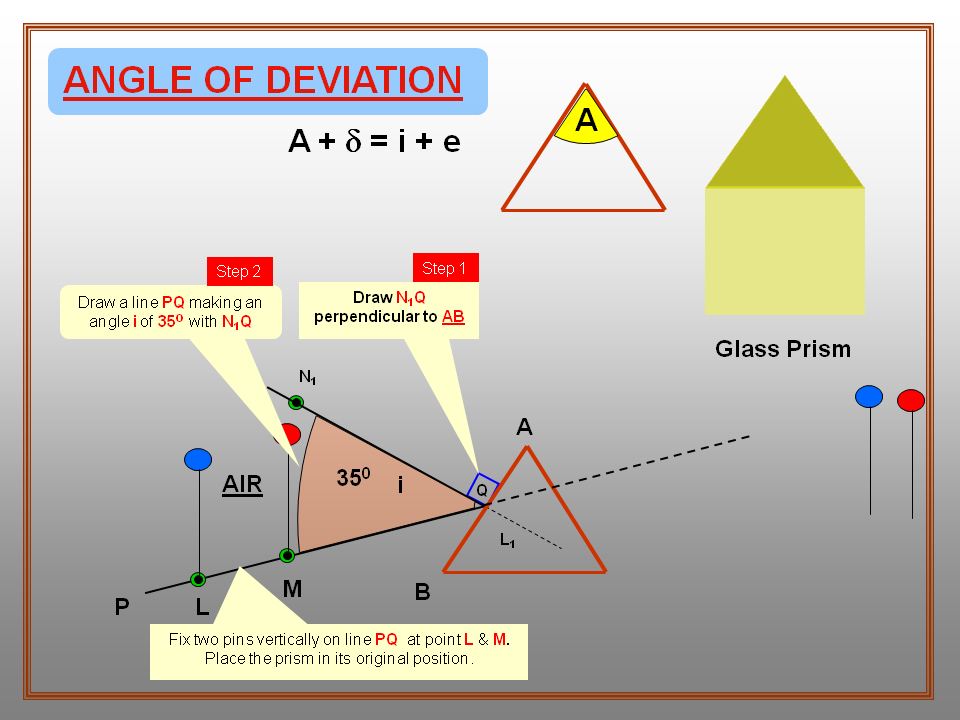
Draw N1Q perpendicular to AB
Draw a line PQ making an angle i of 35O with N1Q
NOTE :- Pins should be 3 – 4 cm. away from each other.
Fix two pins vertically on line PQ  at point L & M.
Refractive index of  Glass Prism procedure
Place the prism in its original position.
Refraction takes place QR after placing prism on its original place
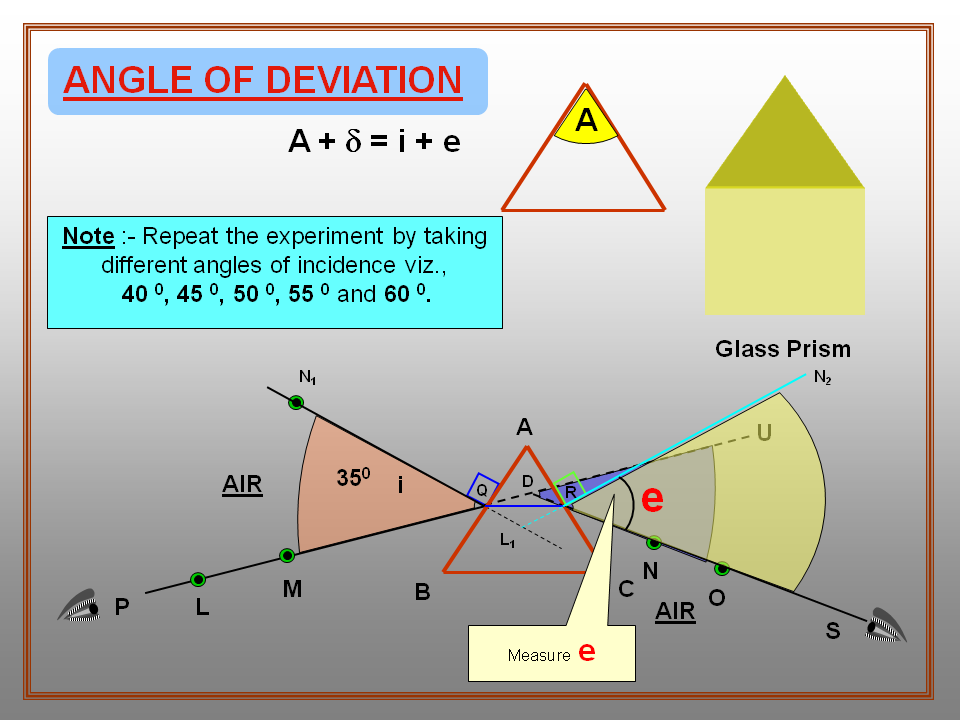
Now look from surface AC, adjust pin N & O vertically on the side which you are looking so that the images of the pins L & M and the pin N & O appear to be in the same straight line.
Refractive index of  Glass Prism procedure
Draw a line  SR
Measure d = Ð UDN
Refractive index of  Glass Prism procedure
Draw a line SR, and draw a perpendicular N2R at R to the line AC
Measure  e (Angle of Deviation)
Refractive index of  Glass Prism procedure
Note :- Repeat the experiment by taking different angles of incidence viz.,
 40 0, 45 0, 50 0, 55 0 and 60 0.

For more details View Video

Angle of Deviation.

Vernier calliper for std 8 to 12 GSEB Students, & ITI fitter measuring instruments.

Vernier calliper measuring instrument for ITI fitter and Gseb students.

Vernier calliper 


A calliper is a device used to measure the distance between two opposing sides of an object. It can be as simple as a compass with inward or outward-facing points. First the tips of the calliper are adjusted to fit across the points to be measured and the calliper is then removed and the distance between the tips is measured using a ruler.

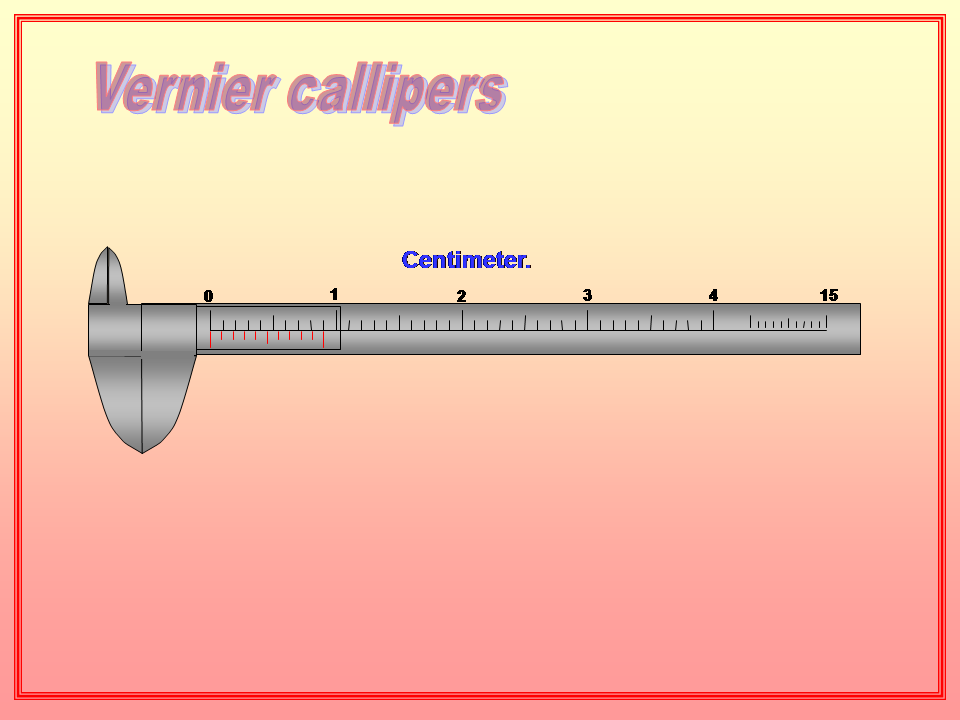
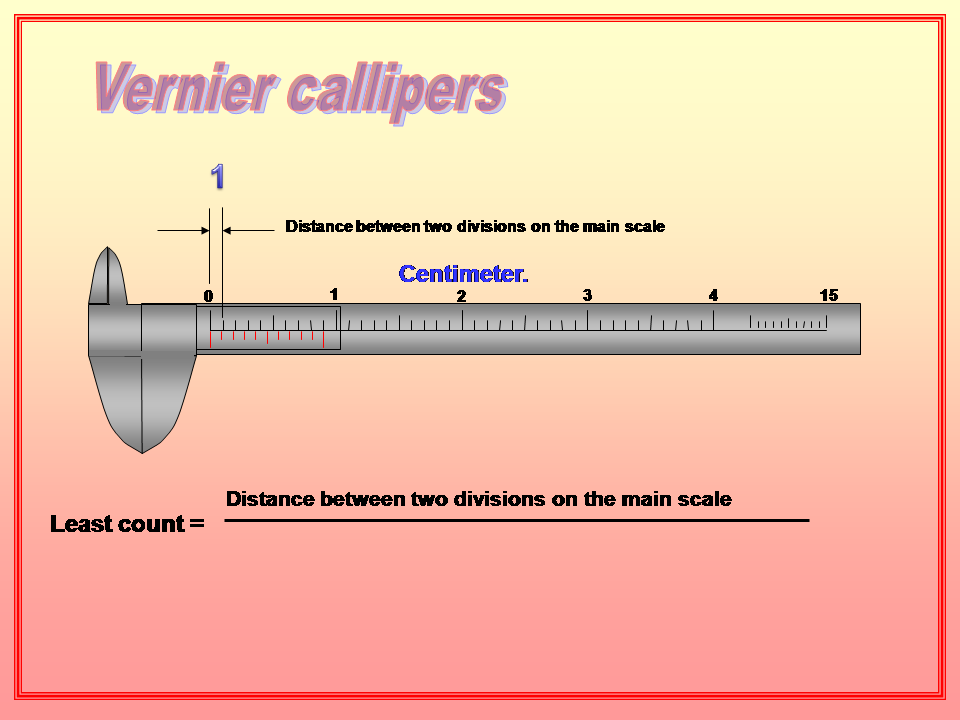
The modern Vernier calliper was invented by Joseph R. Brown in 1851. It was the first practical tool for exact measurements that could be sold at an affordable price to ordinary machinists.   The Vernier Calliper consists of a main scale fitted with a jaw at one end. Another jaw, containing the vernier scale, moves over the main scale. When the two jaws are in contact, the zero of the main scale and the zero of the Vernier scale should coincide. If both the zeros do not coincide, there will be a positive or negative zero error.

1.Main Scale
The main scale consists of a steel metallic strip graduated in centimeters at one edge and in inches at the other edge . It carries the inner and outer measuring jaws. When the two jaws are in contact, the zero of the main scale and the zero of the Vernier scale should coincide. If both the zeros do not coincide, there will be a positive or negative zero error.
Vernier calliper
Least count of Vernier
Vernier calliper Main Scale
Vernier calliper 
Vernier calliper calculation
Vernier Calliper
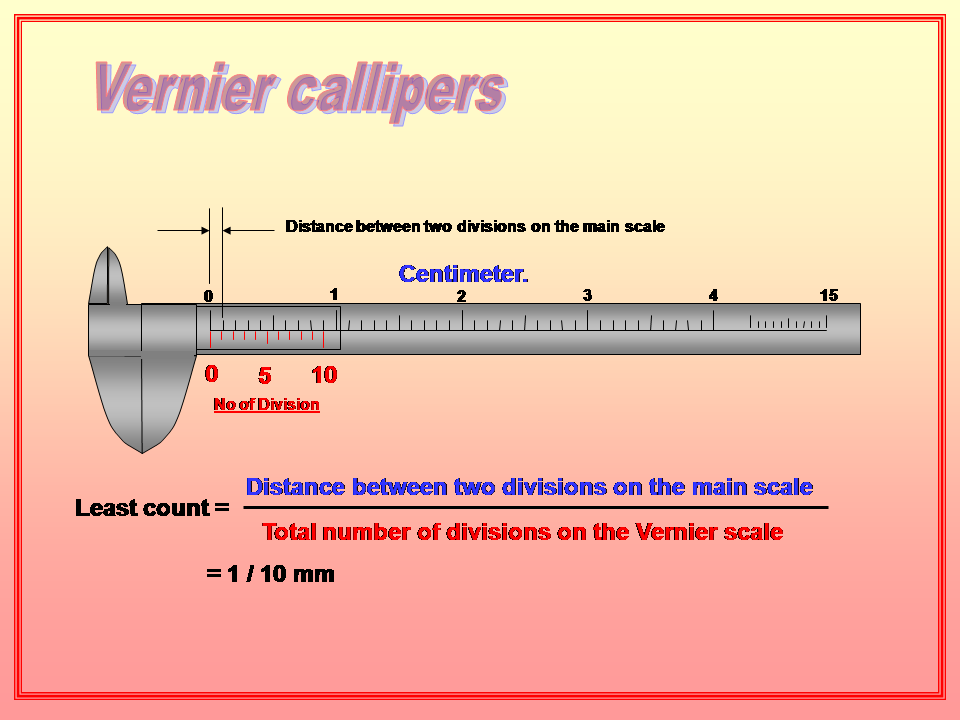
vernier calliper least count
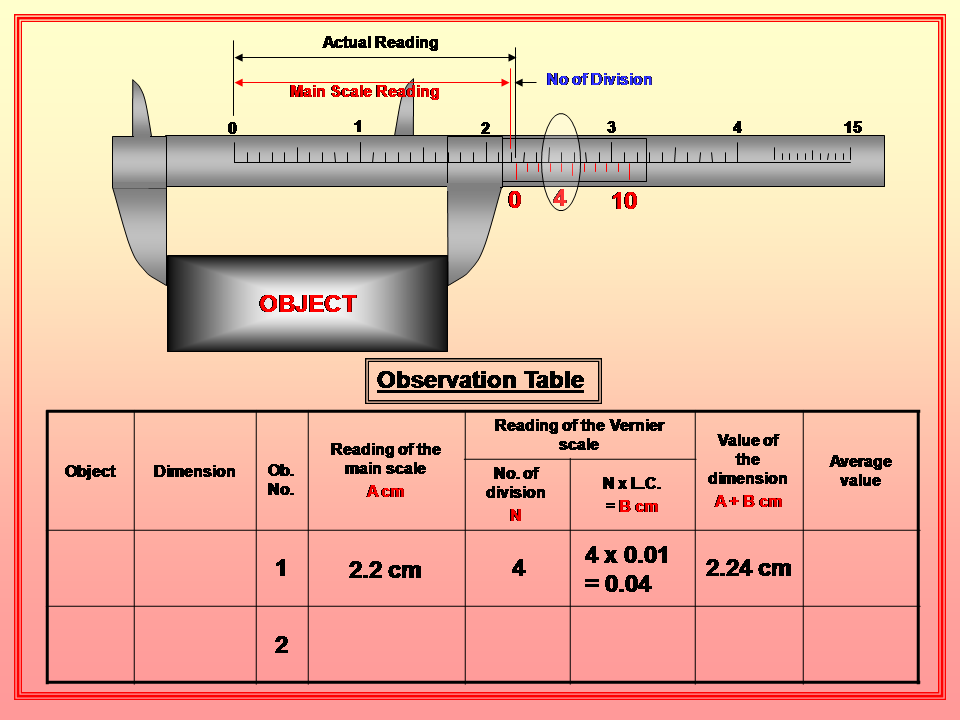
vernier calliper least count and Table
vernier calliper Measuring rectangle
2. Vernier Scale
A vernier scale  slides on the strip. It can be fixed in any position by the retainer. On the Vernier scale, 0.9 cm is divided into ten equal parts.

3. Outer Measuring Jaws
The outer measuring jaws helps to take the outer dimension of an object

4. Inner Measuring Jaws
The inner measuring jaws helps to take the inner dimension of an object.

5. Retainer
The retainer helps to retain the object within the jaws of the Vernier calipers.

6.  Depth Measuring Prong
The depth measuring prong helps to measure the depth of an object.

Least Count

The least count or the smallest reading which you can get with the instrument can be calculated as;

First calculate the least count and only then place the object between the two jaws.

Record the position of zero of the Vernier scale on the main scale.
Calculating the Reading

When a body is between the jaws of the Vernier Calliper.

More details view video:
Vernier calliper video Measuring rectangle practical.


pH value of solution and fruit juices GSEB std 8 to 12 Science

ph Value of Fruit juice


To determine the pH value of solution and fruit juices with the use of pH-paper approximately.

AIM  : To determine the pH value of solution and fruit juices with the use of pH-paper approximately

APPARATUS   : Seven glass  test tubes, one dropper, Test tube stand, and glass rod. Dilute hydrochloric acid solution,Lemon juice, Tomato juice, Distilled water, Sodium chloride solution, Sodium hydroxide solution, Sodium carbonate solution,

THEORY  :  [ The pH scale runs from 0 to 14 ]
If the pH of a solution is 7 it is a neutral solution. pH of acid is less then seven and that of base is more than seven.
Thus the nature of solution whether neutral, acidic or basic can be known by knowing by pH value of  solution. In the school laboratory pH value is determined by using pH papers. The basic principle of the pH paper is that it undergoes a suitable change in colour which is characteristic of the pH of the test sample of the solution. In this way pH paper is an indicator in different media of solutions giving different colour.
In the laboratory red and blue litmus papers are also used to find pH value less than 7 pH, more than7pH and 7pH.
pH value of solution and fruit juices
ph value of Dilute hydrochloric acid
pH value of solution and fruit juices

ph vales of Sodium chloride solution
ph vales of different Fruit juice
ph values table 
CONCLUSION

PRACTICAL USES : From pH value the property of substance or solution whether acidic, neutral or basic can be determined.