Showing posts with label Key. Show all posts

Monday, April 7, 2025

MEASUREMENT OF RESISTANCE ( WHEATSTONE’S BRIDGE) gseb std 11 & 12 physics practical.

Wheatstone's bridge
MEASUREMENT OF RESISTANCE
            ( WHEATSTONE’S BRIDGE)


Condition (1) :- MEASUREMENT OF RESISTANCE

AIM :-
You are given a Wheatstone bridge and other necessary instruments. Find the values of the unknown resistance Rx. Exchange the positions of unknown resistance and resistance box in the gaps of Wheatstone bridge and repeat the experiment.
PRINCIPLE :-
It works on the principle of balanced Wheatstone bridge.
Apparatus :-
Wheatstone-bridge (meter-bridge),
2 Volt Battery,
Rheostat,
Galvanometer,          
Jockey,
Key,
Resistance box(1 – 100  W),
Resistance coil.
Precautions
  1. Make proper and tight connections.
  2. Keep the keys tightly closed in the resistance box.
  3. Adjust the value of resistance box so that null point is obtained between 40 cm and 60 cm.
  4. Do not slide the jokey continuously over the wire. 
Note :-  Keep high resistance of rheostat in the beginning of each observation so that current is less and the galvanometer is not damaged. After getting approximate position of null point only decrease the resistance of rheostat.
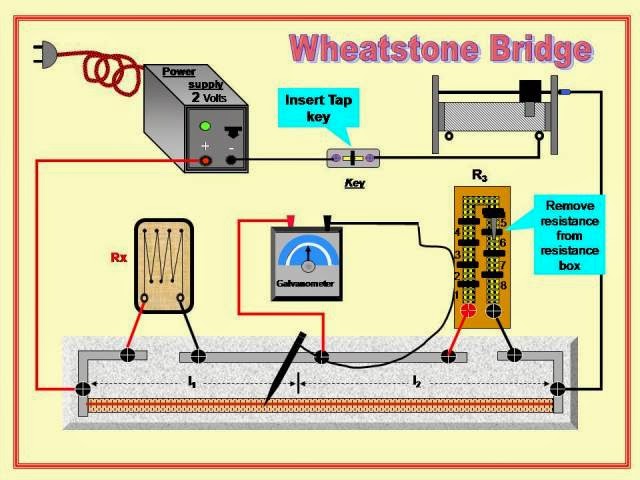
Wheatstone's bridge Appartatus
Wheatstone's bridge Practical
Wheatstone's bridge
Wheatstone's bridge Observation table
Wheatstone Bridge    ( Line Diagram )

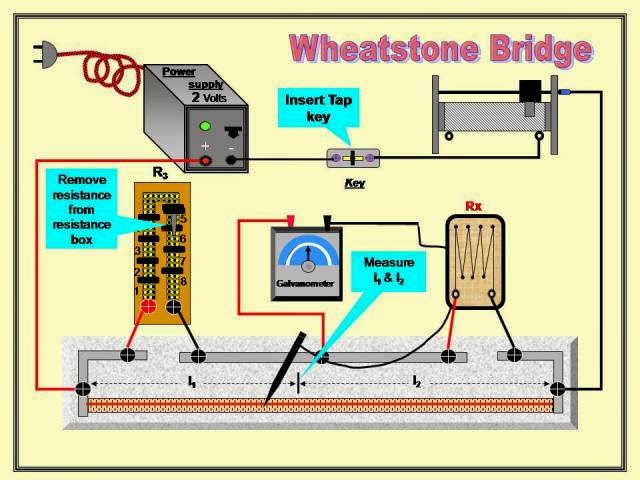
(2)  Condition :- Interchange unknown resistance Rx between  P – Q.
Wheatstones bridge appartatus
Wheatstone's bridge practical
Wheatstones bridge observation table
Wheatstosnes bridge conclusion
For more details view Video
MEASUREMENT OF RESISTANCE
            ( WHEATSTONE’S BRIDGE)

Friday, October 27, 2023

LAWS OF COMBINATION OF RESISTORS ( WHEATSTONE’S BRIDGE & POST OFFICE BOX ) Physics practical gseb std 11 & 12

Wheatstone's bridge


 LAWS OF COMBINATION OF RESISTORS
( WHEATSTONE’S BRIDGE & POST OFFICE BOX )

Experiment :- 3.1
AIM :-
You are given a Wheatstone Bridge and other necessary instruments.
Find the values of the unknown resistance Rx and Ry .
Now connect them in series and parallel respectively and measure their resultant resistances and test the laws of series and parallel connections.
PRINCIPLE :-
It works on the  principle of a balanced Wheatstone bridge.
Apparatus :-
Wheatstone-bridge (meter-bridge),
2 Volt Battery,
Rheostat,
Galvanometer, 
Jockey,
Key,
Resistance box(1 – 100  W),
Resistance coil.

Precautions
(1)   Make all connections tight.
(2)    Clean the ends of the connecting wire with a sand paper.
(3)    Plug keys of resistance box should be very tight.
(4)     Adjust the value of R from the resistance box such that null-point is obtained between 40 cm. and 60 cm.
Laws of combination of resistors
Wheatstone's bridge Apparatus
Wheatstone's bridge Line Diagram
Wheatstone's bridge Practical
Wheatstone's bridge Observation table
(2)   Condition :-
Connect unknown resistance Ry between  M – N.
 
Wheatstone's bridge Line diagram
Wheatstone's bridge line diagram
Wheatstone's bridge Practical
Wheatstone's bridge observation table 2
 (3)   Condition :-
Connect unknown resistance Rx & Ry in Series.
 
Wheatstone's bridge series connection condition 3
Wheatstone's bridge condition 3 Line diagram 
wheatstone's bridge practical
Wheatstones bridge observation table condition 3
(4) Condition :-
Connect unknown resistance in Parallel .
Wheatstones bridge parallel connection
Wheatstones bridge parallel connection practical
wheatstones connection conclusion

Wednesday, March 25, 2015

COMPARISION OF EMF , principle of potentiometer GSEB std 11 & 12 Physics practical

Comparision of emf


COMPARISION OF EMF 
Experiment  6(a)

AIM :-
Two cells EA and EB, a potentiometer and necessary components are given. Connect EA and EB one after the other and find the ratio of their emfs.

PRINCIPLE :
It works on the principle of potentiometer.

APPARATUS:
A resistive wire, Laclanche cell, Daniel cell, a main battery, two rheostats, Potentiometer, jokey, key, Galvanometer, Resistance box,
Apparatus for comparision of EMF
Adjust all apparatus as per shown here
Line Diagram fof Comparision of EMF
Comparison of EMF Practical
Comparison of EMF Practica
Comparison of EMF Practical Procedure
Calculation table for Comparison of EMF
Experiment  6(b)
AIM :-
Verify the results by joining both the cells in helping and opposing conditions.

APPARATUS :
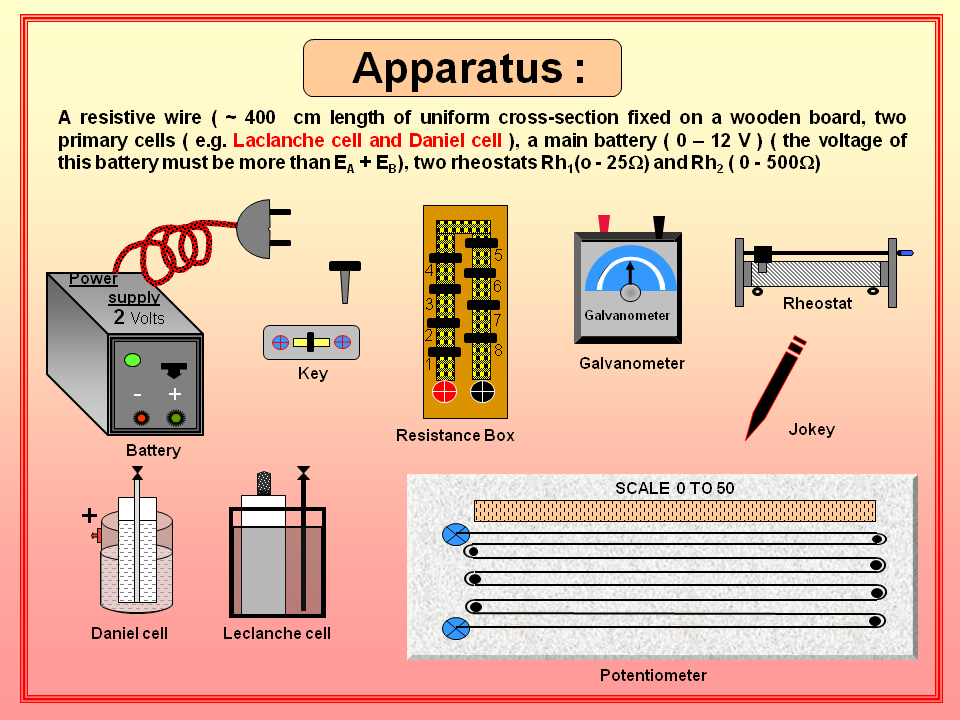
A resistive wire ( ~ 400  cm length of uniform cross-section fixed on a wooden board, two primary cells ( e.g. Laclanche cell and Daniel cell ), a main battery ( 0 – 12 V ) ( the voltage of this battery must be more than EA + EB), two rheostats Rh1(o - 25W) and Rh2 ( 0 - 500W)
Apparatus of Comparision of EMF (ii)
PRECAUTIONS
1    First decide from experiment :6(a), which cell has larger emf. Call that cell EA and the other cell EB
2      Here, Rh1 should be having smaller resistance than Rh2.
3      The value of Rh1 should be the same while taking observations for EA and EB.
            For the observation of each set of helping-opposing conditions, the resistance in Rh1 should not be changed.
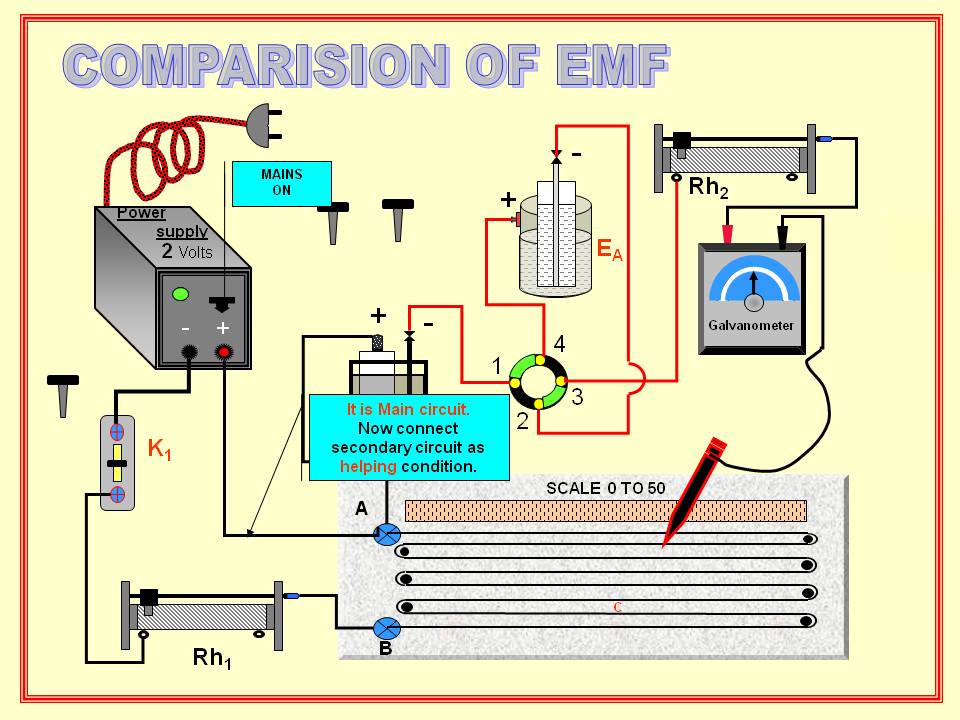
Line diagram Comparision of EMF (Helping Connection)
Comparision of EMF Practical

Comparision of EMF Practical
Result :
1  By connecting EA and EB separately :  EA / EB = ……………
2   By connecting EA and EB in helping and opposing conditions : EA / EB = ……..