Sunday, July 19, 2026

To prepare sulphur dioxide gas in the laboratory Std 8 to 12 Science practical.

Preparation of Sulphur Dioxide in Laboratory


To prepare sulphur dioxide gas in the laboratory. 
AIM :  To prepare sulphur dioxide gas in the laboratory and study its properties.
It is known from the properties of sulphur dioxide that it is extremely pungent smelling colourless bacteriostatic gas. Excess of sulphur dioxide in the air causes air pollution. When it escapes from engine exhaust and factory  chimneys it causes pollution. It is suffocating and leads respiratory inflammation. For this reason it is necessary to reduce  its proportion from the air.
THEORY :  Copper metal and concentrated sulphuric acid reacts to give corresponding  acid salt ( copper sulphate ) and sulphur dioxide gas.
APPARATUS  : Round bottom flask, thistle funnel, delivery tube, four to five gas jars, stand, two-holed cork, lid, wire gauze, tripod stand, etc.

CHEMICALS  : Copper metal, Sulphuric acid, red and blue litmus papers, wax, potassium permanganate, magnesium strip etc.
Preparation of Sulphur dioxide in Laboratory
Observation :- 

Physical properties :
  1. Colour of sulphur dioxide gas :
  2.  Odour or small of sulphur dioxide gas:
  3.  Solubility of the gas in water :
  4.  During the experiment this gas is collected by the upward displacement of air, therefore this gas is                    than air.
Chemical properties :
  1. When red and blue litmus papers are inserted in gas jar containing sulphur dioxide.
  2.  When an ignited magnesium ribbon is held in a gas jar containing sulphur dioxide.
  3.  When potassium permanganate solution is added to the gas jar containing sulphur dioxide.
  4.  Give the chemical reaction, which is used to prepare sulphur dioxide in laboratory.
CONCLUSION :-

PRACTICAL USES
It is known from the properties of sulphur dioxide that it is extremely pungent smelling colourless bacteriostatic gas. Excess of sulphur dioxide in the air causes air pollution. When it escapes from engine exhaust and factory  chimneys it causes pollution. It is suffocating and leads respiratory inflammation. For this reason it is necessary to reduce  its proportion from the air.

For more details View Video:

To prepare sulphur dioxide gas in the laboratory. 

To test the presence of Carbon monoxide and Sulphur dioxide in the atmosphere. Biology std 11 & 12

To test the presence of Carbon monoxide and Sulphur dioxide in the atmosphere.
Test of Carbon  and Sulphur dioxide


INSTRUMENTS
Filter paper,  
Palladium or Platinum chloride, Acidic potasium dichromate.
Test for Carbon monoxide
Filter paper deep in chemical
Keep where transportation is more and smoke of automobiles is very high
View the changes on filter paper.
Slowly slowly it gets change in colour.
After some times 
Finally you see the change in colour that is due to Carbon monoxide is presence in Air.


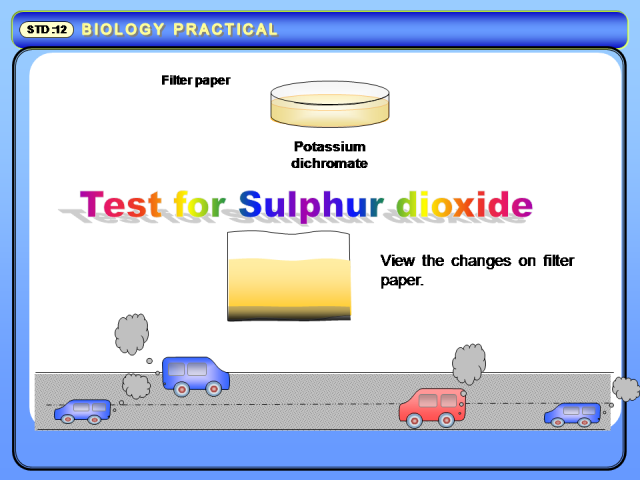
Test for Sulphur dioxide
Filter paper deep in chemical
Keep where transportation is more and smoke of automobiles is very high
View the changes on filter paper.
Slowly slowly it gets change in colour.
After some times 

Finally you see the change in colour that is due to Sulphur dioxide  is presence in Air.


For more details view Video
To test the presence of Carbon monoxide and Sulphur dioxide in the atmosphere.

Angle of deviation of GLASS PRISM, GBSE practical for std 11 & 12.

Angle of Deviation of Glass Prism


ANGLE OF DEVIATION OF GLASS PRISM, 

12.1  AIM :-
Determine with the help of pins, the angle of the given glass prism. Determine the values of angle of emergence and angle of deviation for four different values of angle of incidence. Hence prove that  i + e = A +d.

PRINCIPLE : Reflection and refraction of light.

APPARATUS:  Glass Prism, Drawing paper, Drawing board, Pencil, Ruler, Pin, Protector,

PRECAUTIONS
Ø    While marking the position of a prism with pencil, the prism should not be disturbed.
Ø   A prism should be carefully put back exactly at the marked position.
Ø    While pressing the heads of the pins for fixing them use metal coin or a hard object so that you do not hurt your palm.
Ø    Do not press the pins very hard in the board otherwise it becomes difficult to remove them afterwards.
Ø   See that the pins pushed in the board remain perpendicular to the board.

PROCEDURE :
Take paper and pin it on Drawing board. 
Now take Glass prism and put it on center of Drawing board paper.
Mark the edges of the prism with pencil.
Angle of Deviation of Glass Prism Practical

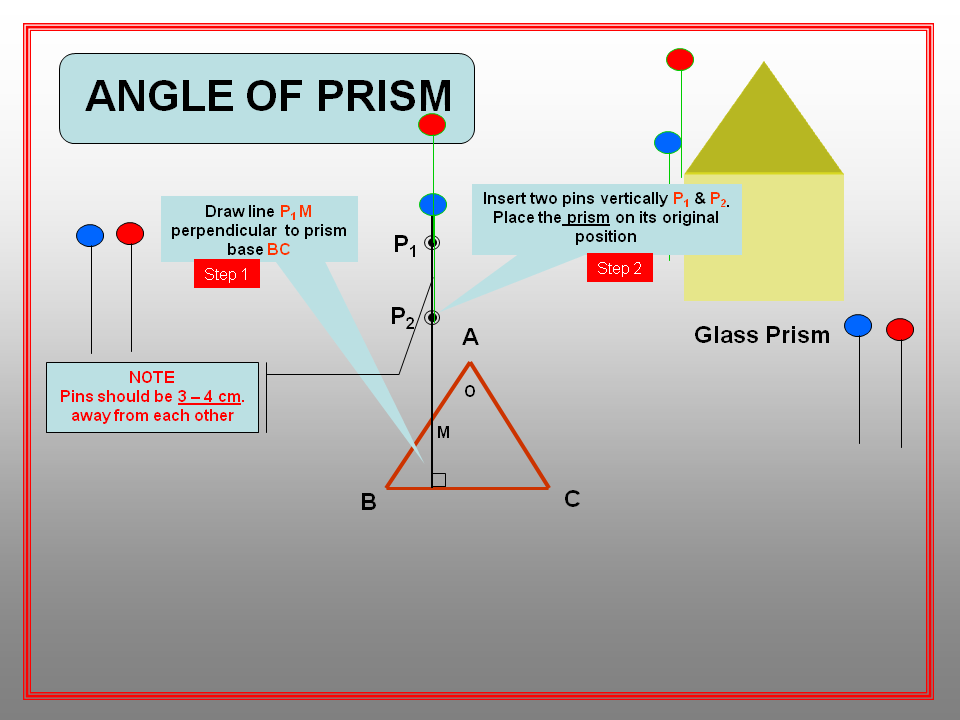
Draw line P1 M perpendicular  to prism base BC.
Insert two pins vertically P1 & P2..
Place the Prism on its original position.
NOTE :- Pins should be 3 – 4 cm. away from each other.
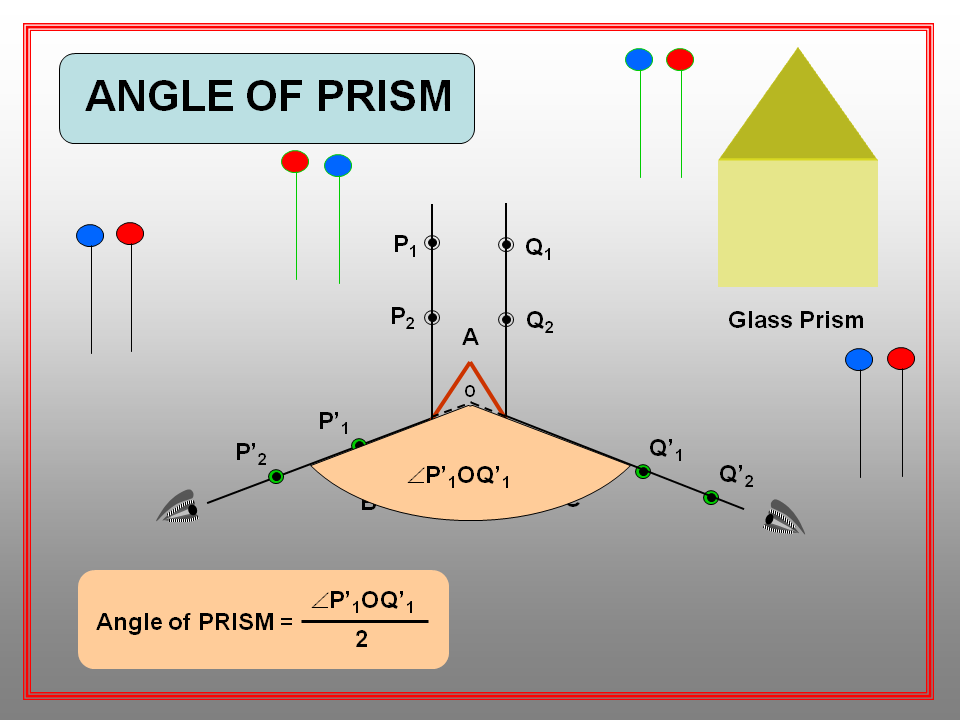
Observe pins from the side AB and insert two pins P’1 & P’2 such that images of P1 ,P2 and pins P’1 & P’2 are collinear.
Angle of Deviation of Glass Prism Procedure
Draw line Q1 N perpendicular  to prism base BC
Insert two pins verticallyQ1 & Q2.
Angle of Deviation of Glass Prism Procedure
Place the prism on its original position
Observe pins from the side AC and insert two pins Q’1 & Q’2 such that images of Q1 ,Q2 and pins Q’1 & Q’2 are collinear.
Angle of Deviation of Glass Prism Procedure
Measure angle with protector ÐP’1OQ’1.

Angle of PRISM = ÐP’1OQ’1  / 2.
Angle of Deviation of Glass Prism Procedure

For more details view Video
Angle of Prism:

Wednesday, July 8, 2026

Copper voltameter, to determine the electro chemical equivalent of copper, physics practical std 11 & 12


Copper voltameter
Copper voltameter


AIM :-
Connect given copper voltameter in an appropriate circuit determine the electro chemical equivalent of copper.
PRINCIPLE :-
On passing electric current through CuSO4 solution, Cu+2 and SO-24 ions are separated or chemical effect of electric current.
PRECAUTIONS
The cathode plate should be throughly cleaned after rubbing with sand paper.
Pass only that much current as is obtained from the calculation of the area of the immersed part of the cathode plate.
Use only a fresh solution of CuSo4. To prepare the solution dissolve about 25 g of CuSO4 crystals in 100 cm3 water. Add a few drops of sulphuric acid (H2SO4) to make it more conducting.
Hold the plate from its upper end so as to avoid touching its surface.
Cathode plate should be washed immediately after it is taken out of the solution.

PROCEDURE :-
1. To Cathode plate  dip in clean water, and wash off all the CuSO4, solution sticking to it. Thereafter wash it again with tap water.
2. Hold it in the sunshine for some time till it dries out. Now find out its mass by Physical balance.

Anode, Cathod, Sulphuric, Copper, voltameter, 
Electric, Solution, Water, 
Copper voltameter apparatus 
Copper voltameter line diagram 
Copper voltameter practical
Copper voltameter practical result
Table of Copper voltameter result
Calculation of copper voltameter
For more details View Video.
Copper voltameter.

BeautifulPictures of Magnet and its properties science std 8 to 12 GSEB

Magnet and its properties


Magnet and its properties picture for science. 
Natural magnet 

Natural magnet properties

Bar magnet properties


Magnetic Needle


Horse Shoe Magnet

Horse shoe Magnet with Keeper


Different types of Magnet


Bar magnet Properties
Replusion of Bar Magnet

Attract of Bar magnet 


Mechanical method of making magnet

Bar magnet keeper 

Electric method of making Magnet

Electric method of making Magnet 

Galvanometer using magnet

lines of force of Magnet

Lines of force of bar magnet

Magnetic Lines of force around magnet

Electric meter using magnet

Fuse use for electric

Voltmeter

Uses of different magnets in products


Yoga with Pramoda Patel

Sonometer relation between frequency and the length, GSEB physics practical std 11 & 12

Sonometer


Sonometer

AIM :-
To study the relation between frequency and the length of a stretched string with the help of a sonometer.
PRECAUTIONS
1  The wire should be of uniform cross-section and there should not be any twist or bend in it.
2   The pulley should rotate without friction.
3   Put that much weight  in the pan so that the deformation produced in the wire should not exceed the elastic limit.
4   The stem of the tuning fork, not its prongs, should be placed on the sonometer box or on the support.

Apparatus:-  A sonometer,  tuning forks ( of frequencies from 256 Hz – 512 Hz),  a pan or a hanger of known weight,  four to five 500 gm weights, a paper rider, a rubber-pad and a meter rule. 
Sonometer Apparatus
Sonometer Practical
OBSERVATION TABLE
Sonometer reading
Sonometer Graph
For more details View Video.
To study the relation between frequency and the length of a stretched string with the help of a sonometer.