Showing posts with label water. Show all posts

Wednesday, July 8, 2026

Copper voltameter, to determine the electro chemical equivalent of copper, physics practical std 11 & 12


Copper voltameter
Copper voltameter


AIM :-
Connect given copper voltameter in an appropriate circuit determine the electro chemical equivalent of copper.
PRINCIPLE :-
On passing electric current through CuSO4 solution, Cu+2 and SO-24 ions are separated or chemical effect of electric current.
PRECAUTIONS
The cathode plate should be throughly cleaned after rubbing with sand paper.
Pass only that much current as is obtained from the calculation of the area of the immersed part of the cathode plate.
Use only a fresh solution of CuSo4. To prepare the solution dissolve about 25 g of CuSO4 crystals in 100 cm3 water. Add a few drops of sulphuric acid (H2SO4) to make it more conducting.
Hold the plate from its upper end so as to avoid touching its surface.
Cathode plate should be washed immediately after it is taken out of the solution.

PROCEDURE :-
1. To Cathode plate  dip in clean water, and wash off all the CuSO4, solution sticking to it. Thereafter wash it again with tap water.
2. Hold it in the sunshine for some time till it dries out. Now find out its mass by Physical balance.

Anode, Cathod, Sulphuric, Copper, voltameter, 
Electric, Solution, Water, 
Copper voltameter apparatus 
Copper voltameter line diagram 
Copper voltameter practical
Copper voltameter practical result
Table of Copper voltameter result
Calculation of copper voltameter
For more details View Video.
Copper voltameter.

Thursday, June 11, 2026

Rocks, Minerals and Metals, for Standard 8 theory and practical With Understanding drawings.

Science for Standard 8 theory and practical With Understanding drawings.
Rocks, Minral and Metals
Rocks, Minerals and Metals
Rocks are found on the crust of the earth and made up of mineral
SHALE,
LIMESTONE,
SANDSTONE,
FOLDED ROCK FORMATION,
GAS,
OIL,
WATER,

IRON ROCK,
Rocks Minral and Metals 
Some are coarse grained as granite. Clay has much fine grains that we cannot see them separately. If you closely examine a piece of granite, you will find that it is made up of a number of substances under a magnifying lens or a microscope. Substances which assemble together to form rocks are called minerals. Minerals are naturally occurring inorganic substances.   
Magnifying lens to see sand grade 
Tags:- Rocks, Mineral, Metal, Shale, Limestone, Sandstone, Rock_Formation, Gas, Oil, Water, Iron_Rock
The Earth’s Crust
Remainder of the crust consists of mainly six metals
(1) Aluminum (most abundant)
(2) Iron
(3) Calcium
(4) Sodium
(5) Potassium
(6) Magnesium.

Three forth of the earth crust is made just of two non metals.
(1) Oxygen (2) Silicon.

The average thickness of earth crust is 35 km under the continents and 10 km under the oceans.
Earth Crust
Tag:- Aluminum, Iron, Calcium, Sodium, Potassium, Magnesium, Earth’s_Crust
Rocks formation
Meaning:- Word derived from the latin word ‘ignis’ meaning fire. First rock to appear on the earth’s  surface.
Formation:- Formed by the cooling and solidification of extremely hot molten material, magma below the earth crust.
               This magma pushes its way through earth’s crust with high pressure to form igneous rocks.
 Large part of west central part of our country called the Decean Plateau.
Granite is formed when the rising magma solidifies before reaching the surface in the form of coarse grained.
Igneous Rocks
By the deposition fo sediments SEDIMENTS are broken down particles of existing rocks which are deposited layers by layers by flowing water or wind in the sea along with dead plants and animals.
 All this are neatly preserved in the sediments.
 The process goes on for millions of years and the resultant rocks are called Sedimentary rocks.
 Sedimentary rocks contains the relics of plants & animal known as Fossils.
 They harden with age.
 Thickness of overlaying layers are usually soft.
Sedimentary Rocks
FORMATION :- When igneous or sedimentary rocks are subjected to intense heat, compression or fluid injection the physical & chemical properties changes which results in metamorphic rock

Metamorphic Rocs
Tag:- ignis, Igneous Rocks, Sedimentary  Rocks, Metamorphic Rocks, Heat,  Pressure, Formation
 Minerals
 Naturally occuring inorganic substances with specific composition.
 Substance which assemble together to form rocks are called Minerals. There are about 2000 distinctive minerals.
 A mineral made of atom of a single element or of more than one elements.
 It is identified by its physical properties such as colour, lustre,    hardness, specific gravity and cleavage. 
Types of Mineral
Non-metallic minerals and their uses
Minerals and their uses

Uses of Minerals
Some common ores :-
Some Common Ores
Tag: - Galena, Magnetite, Pyrite, Oxide, Sulphide, Aluminium, iron, Copper, Lead, Quarz, Feldspur , Mica, Rock salt, Gypsum, Talc, Pitch blend, Monazite.

BLAST FURNACE
Blast furnace and its structure

Blast furnace total height is about 30-40 meters.

FeO + CO ® Fe + CO2
Iron oxide, limestone & coke
CaCO3heat CaO + CO2
CaO + SiO2  ®CasiO3
Impurities slag
Fe2O3  + C ® 2 Fe3O4 + CO
Fe3O4  + CO ® 3 FeO + CO2

Out side portion is made up of steel, and inside portion is lined with fire bricks.
Middle portion of the furnace is known as BOSCH.its width is about 7-8 meters.
Cone & Glass shape
HOT AIR
Waste gas
SLAG
Calcium silicate
MOLTEN IRON
Blast furnace
The concentrated ore along with coke (c) and limestone are added to a blast furnace. Blasts of hot air at about 19000 C are blown into the furnace lined with fire bricks. The coke reduces the ore to metallic iron. The molten iron collects at the bottom of the furnace. Limestone on heating decomposes to calcium oxide and carbon dioxide. Calcium oxide reacts with the sand and forms a slag (calcium silicate. 
Pig iron & Wrought iron
Pig iron and Wrought iron
Tag : - Slag, Waste gas, Blast_Furnace, Pig_iron, Wrought_Iron, Molten_iron, Calcium silicate, Iron_oxide

More details view Video Blast Furnace.
Beautiful understanding with animation  of how Blast furnace works. 

Monday, April 7, 2025

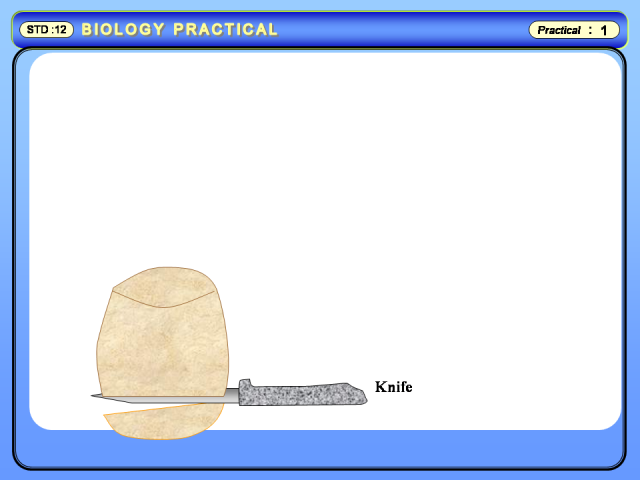
Study of Osmosis by Potato Osmometer, Biology practical std 11 & 12

Study of Osmosis by Potato Osmometer,

Potato Osmosis practical


Study of Osmosis by Potato Osmometer
AIM :-   To study osmosis by potato osmometer.

INSTRUMENTS AND MATERIALS               Petridish, scalpel, pins, Potatoes, sugar, water, eosine (stain). 


Conclusion :-
(A) When Potato bath is placed in  Hypotonic solution due to   osmosis the water flows from petridish containing   hypotonic   solution to the hypertonic solution in the   potato bath  and water   level  increases.

(B) When potato bath is placed in hypertonic solution due to   osmosis the water flows from potato bath containing   hypotonic solution to the hypertonic solution in   petridish and   water level decreases.

(C)  Water flows from petridish to potato bath containing   concentrated   NaCl (Hypertonic solution)

More Details View Video :
Study of Osmosis by Potato Osmometer,

Wednesday, June 5, 2024

RATE OF FLOW OF WATER physics practical GSEB std 11 & 12

RATE OF FLOW OF WATER


AIM :-
Fill water in a cylinder vessel, connected with a capillary, upto some height ho. Allow water to flow through capillary in a controlled way and measure the height (h) of water, in vessel, at regular intervals (t) of time. Take ten such observations. Draw a graph of h ® t and find the half-life of the flow of water.
Apparatus :
Ø  A burette
Ø   A stand
Ø   A beaker
Ø   A stop-watch
Ø   A capillary of fine bore
Ø   A rubber tube
Ø   A pinch cock
Ø   water
Rate of flow of water apparatus
Rate of flow of water Practical
Calculation
Rate of flow of water observation table
Rate of flow of water graph
Rate of flow of water calculation
Graph of rate of flow of water
For more details view Video.
RATE OF FLOW OF WATER

Monday, March 2, 2015

Wave, wave motion, transverse wave, longitudinal wave gseb physics for std 11 &12


Wave and its Characteristics
Waves


Wave, wave motion, transverse wave, longitudinal wave gseb physics for std 11 &12
LET US FLOAT UP &  DOWN WITH
" WAVES "
CALM WATER BEHAVES  LIKE A PLANE  MIRROR, SO WE CAN SEE THE IMAGE ON IT.
WHEN  A STONE IS THROWN,  TRANSVERSE –WAVES PROPAGATE THROUGH WATER & THE IMAGE DISAPPEARS.
Waves 
DEFINITION:-
THE MOTION OF THE DISTURBANCE IN THE ELASTIC MEDIUM OR FREE SPACE IS CALLED A WAVE.

CHARACTERISTICS OF WAVE MOTION
1.WAVE MOTION IS A PERIODIC DISTURBANCE WHICH IS PRODUCED BY A VIBRATING BODY.
2.IN A WAVE MOTION,THE PARTICLES OF THE MEDIUM DO NOT MOVE FROM ONE PLACE TO ANOTHER.THEY ONLY VIBRATE ABOUT FIXED POSITIONS,PASSIVE ON ENERGY THEY POSSESS FROM PARTICLES TO PARTICLE.
3.A WAVE MOTION TRAVELS AT THE SAME SPEED IN ALL DIRECTIONS.
4.A WAVE MOTION TRANSFERS ENERGY FROM ONE POINT TO ANOTHER.IT DOES NOT TRANSFER ANY MATTER.
5.THE VELOCITY OF WAVE MOTION DEPENDS ONLY ON THE MEDIUM AND NOT ON THENATURE OR MOTION OF THE SOURCE.

TYPES OF WAVES.

TRANSEVERSE WAVES
Transverse wave
A WAVE IN WHICH THE PARTICLES OF THE MEDIUM VIBRATE UP AND DOWN AT RIGHT ANGLES TO THE DIRECTION OF WAVE MOTION IS CALLED A TRANSEVERSE WAVE.
EXAMPLES OF TRANSVERSE WAVE.
1.THE WAVES PRODUCED BY MOVING ONE END OF THE ROPE UP AND DOWN.
2.THE WAVES PRODUCED BY THROWING A STONE IN THE WATER.
3.LIGHT WAVES COMING FROM THE SUN.

LONGITUDINAL WAVES.
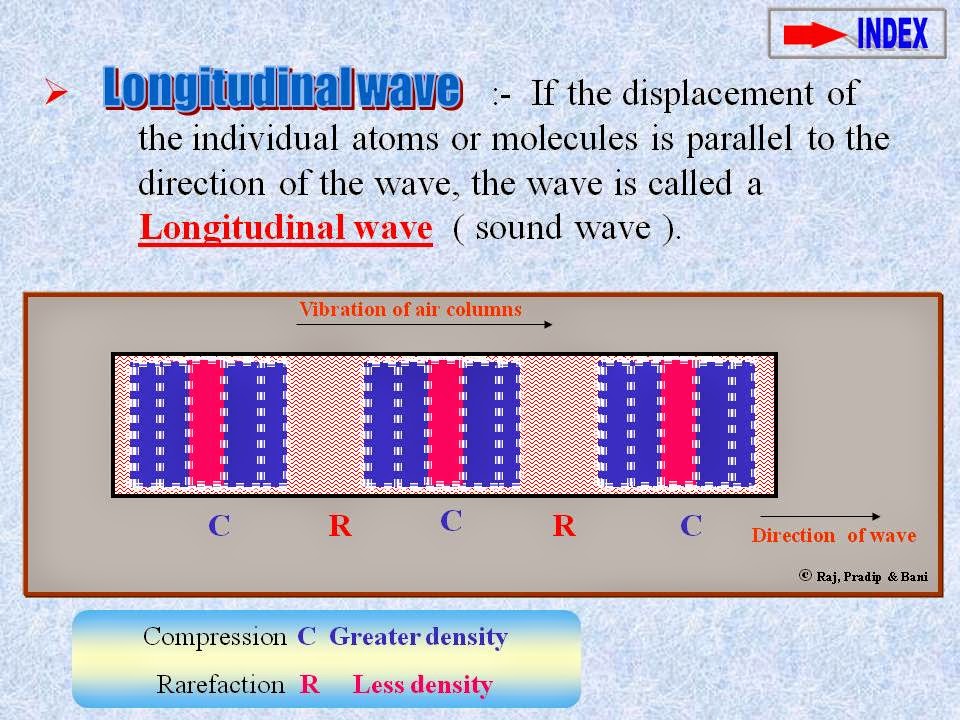
Longitudinal wave
A WAVE IN WHICH THE PARTICLES OF THE MEDIUM VIBRATE BACK AND FORTH IN THE SAME DIRECTION OF THE WAVE IS CALLED A LONGITUDINAL WAVE.
EXAMPLES :-
1. THE WAVES WHICH TRAVEL ALONG A SPRING.     2. THE SOUNDS PRODUCED BY TABLA, VIOLIN,    SITAR  ETC.
                              DISPLACEMENT-DISTANCE  GRAPH  OF TRANSVERSE  WAVE.
DEFFERENCE :-
Transverse wave
THE ELEVATION IN A TRANSVERSE WAVE IS CALLED CREST.
THE DEPRESSION IN A TRANSVERSE WAVE IS CALLED TROUGH.

LONGITUDINAL  WAVE.
Longitudinal wave 
When a longitudinal wave passes through a medium, say air, some of the particles of air get crowded together and form compressions whereas other particles go farther apart and form rarefactions. A longitudinal wave is represented pictorially by showing the compressions and rarefactions.

Waves
waves index
Waves Frequency
Wave length
Waves Amplitude
Waves Velocity
Velocity calculation waves

Types of wave Transverse waves
Longitudinal wave
Standing waves
Musical instrumental waves
Wind instruments waves

wind instruments waves 
String instruments waves

Audible frequency wave
Ultrasonic and subsonic waves
Ultrasonic sounds wave
Ocen depth 
Seismograph 
Doppler effect 
Tuning fork
Acoustics of Auditorium
Test yourself
For more details View Video.
Waves