Showing posts with label Drawing board. Show all posts

Friday, June 12, 2026

REFRACTIVE INDEX OF GLASS PRISM measure with Glass Prism for std 11 & 12 GBSE

Refractive index of  Glass Prism


REFRACTIVE INDEX OF GLASS PRISM 

12.2  AIM :-
Using pins with a given prism determine the angles of deviation for six different values of angle of incidence. Draw the graph of angle of deviation versus angle of incidence. Determine, from this the angle of minimum deviation and using following formula determine refractive index of material of the prism.
Formula for Refractive index of Glass Prism


Angle of prism, A = ……. .

APPARATUS:  Glass Prism, Drawing paper, Drawing board, Pencil, Ruler, Pin, Protector,

FORMULA : - A + d = i + e

PROCEDURE :-
Take paper and pin it on Drawing board. 
Now take Glass prism and put it on center of Drawing board paper.
Mark the edges of the prism with pencil
Refractive index of  Glass Prism procedure
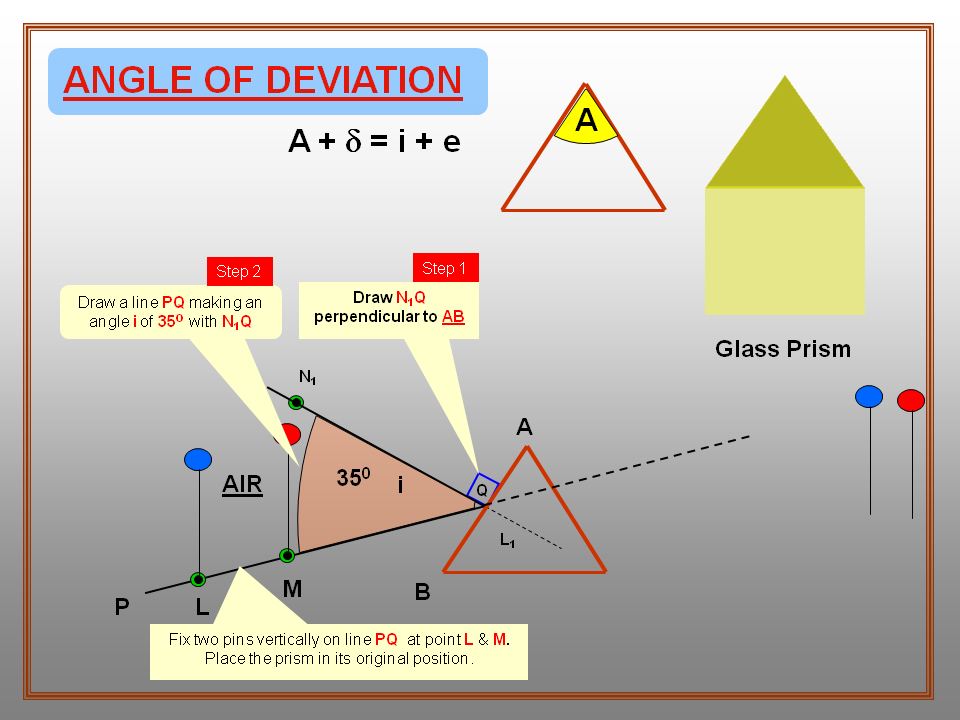
Draw N1Q perpendicular to AB
Draw a line PQ making an angle i of 35O with N1Q
NOTE :- Pins should be 3 – 4 cm. away from each other.
Fix two pins vertically on line PQ  at point L & M.
Refractive index of  Glass Prism procedure
Place the prism in its original position.
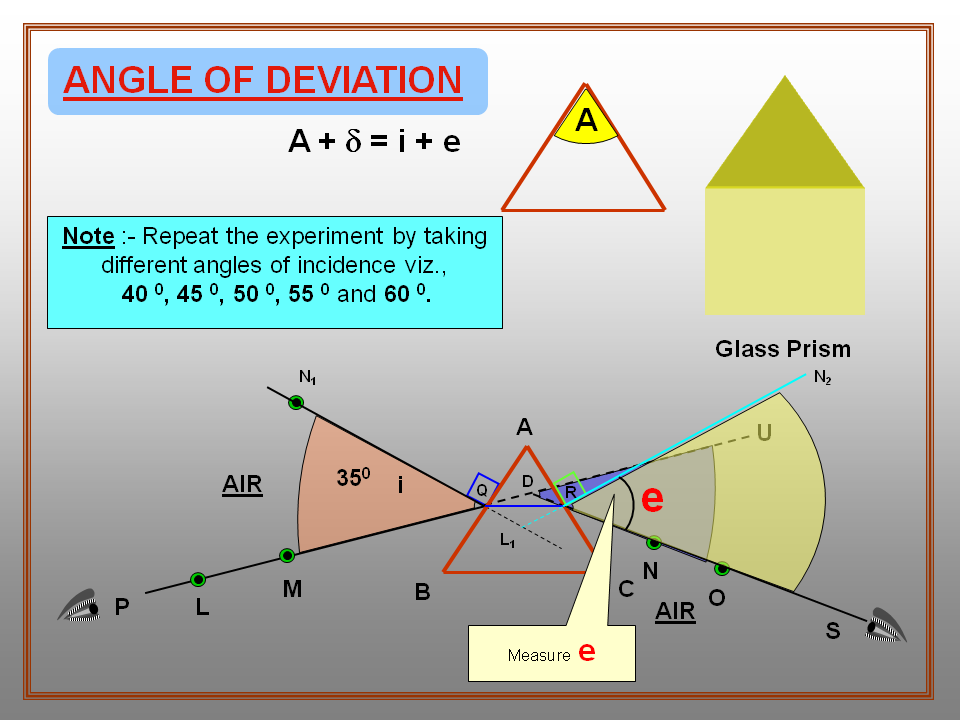
Refraction takes place QR after placing prism on its original place
Now look from surface AC, adjust pin N & O vertically on the side which you are looking so that the images of the pins L & M and the pin N & O appear to be in the same straight line.
Refractive index of  Glass Prism procedure
Draw a line  SR
Measure d = Ð UDN
Refractive index of  Glass Prism procedure
Draw a line SR, and draw a perpendicular N2R at R to the line AC
Measure  e (Angle of Deviation)
Refractive index of  Glass Prism procedure
Note :- Repeat the experiment by taking different angles of incidence viz.,
 40 0, 45 0, 50 0, 55 0 and 60 0.

For more details View Video

Angle of Deviation.

Friday, May 22, 2026

Angle of deviation of GLASS PRISM, GBSE practical for std 11 & 12.

Angle of Deviation of Glass Prism


ANGLE OF DEVIATION OF GLASS PRISM, 

12.1  AIM :-
Determine with the help of pins, the angle of the given glass prism. Determine the values of angle of emergence and angle of deviation for four different values of angle of incidence. Hence prove that  i + e = A +d.

PRINCIPLE : Reflection and refraction of light.

APPARATUS:  Glass Prism, Drawing paper, Drawing board, Pencil, Ruler, Pin, Protector,

PRECAUTIONS
Ø    While marking the position of a prism with pencil, the prism should not be disturbed.
Ø   A prism should be carefully put back exactly at the marked position.
Ø    While pressing the heads of the pins for fixing them use metal coin or a hard object so that you do not hurt your palm.
Ø    Do not press the pins very hard in the board otherwise it becomes difficult to remove them afterwards.
Ø   See that the pins pushed in the board remain perpendicular to the board.

PROCEDURE :
Take paper and pin it on Drawing board. 
Now take Glass prism and put it on center of Drawing board paper.
Mark the edges of the prism with pencil.
Angle of Deviation of Glass Prism Practical

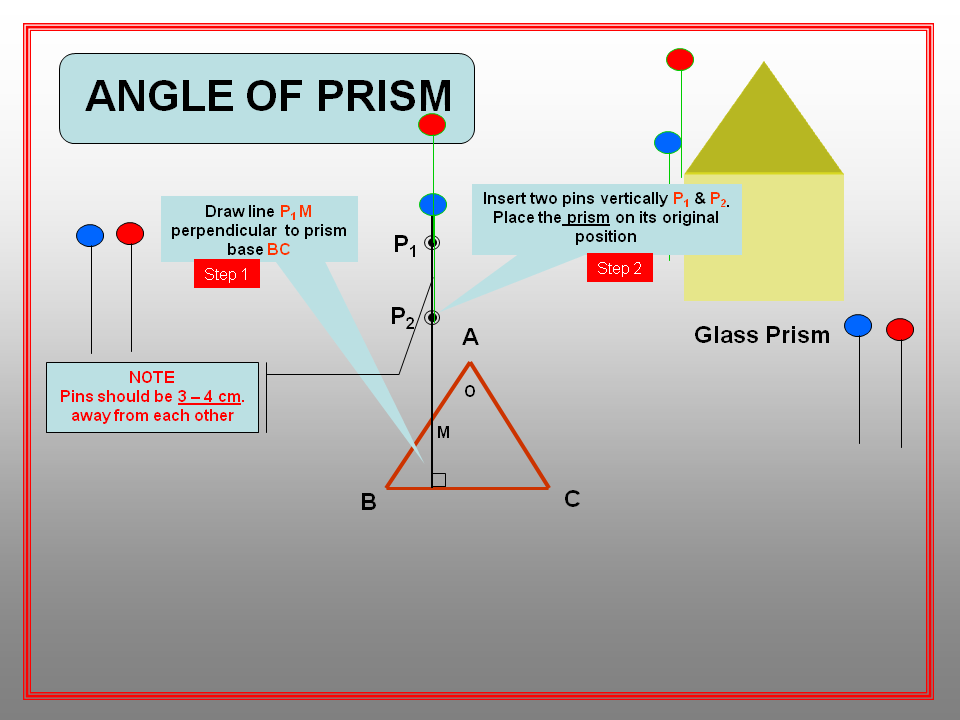
Draw line P1 M perpendicular  to prism base BC.
Insert two pins vertically P1 & P2..
Place the Prism on its original position.
NOTE :- Pins should be 3 – 4 cm. away from each other.
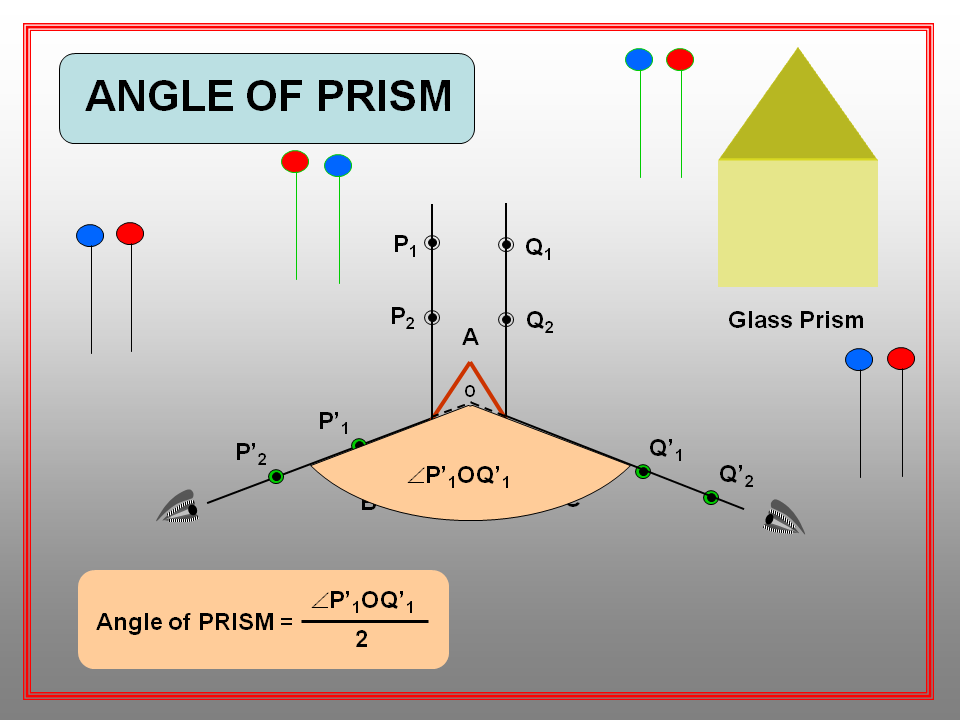
Observe pins from the side AB and insert two pins P’1 & P’2 such that images of P1 ,P2 and pins P’1 & P’2 are collinear.
Angle of Deviation of Glass Prism Procedure
Draw line Q1 N perpendicular  to prism base BC
Insert two pins verticallyQ1 & Q2.
Angle of Deviation of Glass Prism Procedure
Place the prism on its original position
Observe pins from the side AC and insert two pins Q’1 & Q’2 such that images of Q1 ,Q2 and pins Q’1 & Q’2 are collinear.
Angle of Deviation of Glass Prism Procedure
Measure angle with protector ÐP’1OQ’1.

Angle of PRISM = ÐP’1OQ’1  / 2.
Angle of Deviation of Glass Prism Procedure

For more details view Video
Angle of Prism:

Wednesday, June 5, 2024

. TO VERIFY THE LAWS OF REFLECTION USING A PLANE MIRROR GSEB Std 8 to 12 Science practical

Reflection of Plain mirror 
Reflection of Plain mirror.


Aim :   To verify the laws of reflection using a plane mirror.

Principle    :  When a ray of light is incident on a reflecting surface, it changes its direction of motion and travels in the original medium following certain laws. This phenomenon is called  reflection of light.

Apparatus : Drawing board, a drawing paper (White), a plane mirror, a foot-rule, a pencil, four pins, four push pins, a protactor, a stand for the plane mirror.

Apparatus : Drawing board, a drawing paper (White), a plane mirror, a foot-rule, a pencil, four pins, four push pins, a protactor, a stand for the plane mirror.
Reflection of Plain mirror Practical
Reflection of Plain mirror
Ø  First of all fix the white drawing paper on the drawing board using push pins.
Ø  First of all fix the white drawing paper on the drawing board using push pins. Place the plane mirror along with its stand and fix its position AB.
Ø  Now draw a line PQ which passes through the mid-point ‘P’ of AB and perpendicular to AB.
Ø  PQ is called the normal to AB.
Ø  Draw a ray RP which makes some angle with the normal (PQ).
Ø  Draw a ray RP which makes some angle with the normal (PQ). On the ray RP fix two pins P1 and P2 vertically with 2-3 cm separation between them. Ray RP is incident ray.
Ø  Now from the other side of PQ , (in which incident ray is not there) see the images of pins P1 and P2 fix other two pins P3 and P4 vertically so that pins P3, P4 and images P1 and P2 appears collinear at their lower ends.
Ø  Now remove the pins and the mirror. Join the marks of P3 andP4 and obtain the reflected ray PS.
Ø  Repeat  the experiment for different angles of incidence. Measure angle of incidence and angle of reflection. Note your reading in the observations table.

Reflection of Plain mirror
Reflection of Plain mirror Observation table
Conclusion : 
Practical uses :  We can study the laws of reflection. We can also study the images obtained by the plane mirror. We can come to know how reflection is used in various optical appliances, e.g., periscope, keleidoscope.

For more details view Video.
Reflection of Plain mirror.