Friday, October 27, 2023

LAWS OF COMBINATION OF RESISTORS ( WHEATSTONE’S BRIDGE & POST OFFICE BOX ) Physics practical gseb std 11 & 12

Wheatstone's bridge


 LAWS OF COMBINATION OF RESISTORS
( WHEATSTONE’S BRIDGE & POST OFFICE BOX )

Experiment :- 3.1
AIM :-
You are given a Wheatstone Bridge and other necessary instruments.
Find the values of the unknown resistance Rx and Ry .
Now connect them in series and parallel respectively and measure their resultant resistances and test the laws of series and parallel connections.
PRINCIPLE :-
It works on the  principle of a balanced Wheatstone bridge.
Apparatus :-
Wheatstone-bridge (meter-bridge),
2 Volt Battery,
Rheostat,
Galvanometer, 
Jockey,
Key,
Resistance box(1 – 100  W),
Resistance coil.

Precautions
(1)   Make all connections tight.
(2)    Clean the ends of the connecting wire with a sand paper.
(3)    Plug keys of resistance box should be very tight.
(4)     Adjust the value of R from the resistance box such that null-point is obtained between 40 cm. and 60 cm.
Laws of combination of resistors
Wheatstone's bridge Apparatus
Wheatstone's bridge Line Diagram
Wheatstone's bridge Practical
Wheatstone's bridge Observation table
(2)   Condition :-
Connect unknown resistance Ry between  M – N.
 
Wheatstone's bridge Line diagram
Wheatstone's bridge line diagram
Wheatstone's bridge Practical
Wheatstone's bridge observation table 2
 (3)   Condition :-
Connect unknown resistance Rx & Ry in Series.
 
Wheatstone's bridge series connection condition 3
Wheatstone's bridge condition 3 Line diagram 
wheatstone's bridge practical
Wheatstones bridge observation table condition 3
(4) Condition :-
Connect unknown resistance in Parallel .
Wheatstones bridge parallel connection
Wheatstones bridge parallel connection practical
wheatstones connection conclusion

Saturday, March 28, 2015

Find resistance of two resistors series and parallel, std 8 to 12 GSEB

Effective resistance of two resistor practical


To find effective resistance of two resistors connected in (1) Series (2) Parallel connection.
(ohm’s Law)

AIM : To find effective resistance of two resistors connected in (1) Series (2) Parallel connection.

PRINCIPLE  :  When two resistors are connected in series effective resistance is equal to the sum of their resistance. When two resistors are connected in parallel connection reciprocal of effective resistance is equal to the sum of reciprocal of the resistance.

APPARATUS  :   Ammeter ( 0 – 500 mA), Voltmeter ( 0 -10 V ),  Battery eliminator ( 0 – 12 V), Two unknown  resistors, Plug-key, rheostat, wires,
Find Resistance of Resistor Practical
SERIES CONNECTION
Find Resistance of Resistor Practical
PARALLEL CONNECTION
Find Resistance of Resistor Practical
Observation table of Resistor practical
CONCLUSION
(1) Average value of resistance  R1 =             W          
(2) Average value of resistance  R2 =         W
(3) Average value of effective resistance in series connection R3 =     W
(4) Average value of effective resistance in parallel connection R4 =     W        
Note : Verify :    (1) R3 = R1 + R2 for series connection.
                               (2) 1/ R4 = 1/ R1 + 1/R2 for parallel connection

PRACTICAL USES

Many times resistance are connected in series e.g. series of small bulbs used for decoration. Domestic connections are always in parallel, e.g. bulbs, tube-light, t.v., fridge. Etc.

Determine focal length of Convex lens of a far distance object std 8 to 12 GBSE.

Focal length of Convex lens


To determine the focal length of a convex lens by obtaining an image of a far distance object. 
AIM  : To determine the focal length of a convex lens by obtaining an  image of a far distance object.

PRINCIPLE   :  Rays parallel to the axis, after being refracted by a convex lens, are focused on the principal focus. Distance between the optical centre and the principal focus is known as the focal length.

APPARATUS   :   Convex lens, Stand, Screen, Foot-rule, Paper, Pencil,

Convex lens to find Focal lens
Observation

Conclusion

Practical uses

Convex lens of proper focal length are usedin optical instruments like simple microscope, compound microscope, telescope, etc,. Also the method given here in the simplest way to estimate the focal length of a convex lens.

TANGENT GALVANOMETER, Physics practical std 11 & 12 GSEB

Tangent Galvanometer
TANGENT GALVANOMETER, 


AIM :
To determine the value of H with the help of a tangent galvanometer.

APPARATUS :
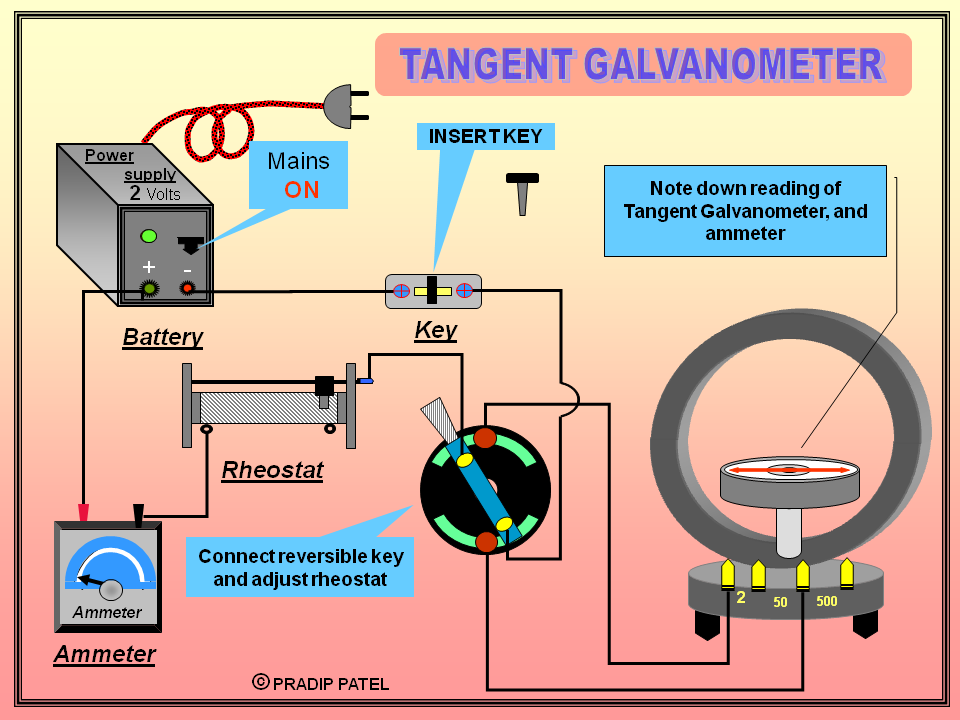
A tangent galvanometer, an ammeter, a battery, a simple key, a rheostat, a reversible key and a spirit level.

PRECAUTIONS
1)      Keep the tangent galvanometer away from an ammeter.
2)       The circular platform must be properly leveled horizontally.
3)       Before taking the reading of the pointer of a tangent galvanometer, the sight should be so adjusted that the pointer and its image in the mirror, become collinear.
4)       The rheostat should be so adjusted that the deflection is between 300 and 600.
5)       The coil of the tangent galvanometer should be adjusted parallel to the magnetic field of the earth.

Apparatus for Tangent Galvanometer Practical
Line Digram for Tangent Galvanometer
Insert Key.
Tangent Galvanometer Procedure
Connect reversible key and adjust rheostat.
Note down reading of Tangent Galvanometer, and ammeter.
Tangent Galvanometer Procedure
Connect  key in reverse position and adjust rheostat.

Wednesday, March 25, 2015

COMPARISION OF EMF , principle of potentiometer GSEB std 11 & 12 Physics practical

Comparision of emf


COMPARISION OF EMF 
Experiment  6(a)

AIM :-
Two cells EA and EB, a potentiometer and necessary components are given. Connect EA and EB one after the other and find the ratio of their emfs.

PRINCIPLE :
It works on the principle of potentiometer.

APPARATUS:
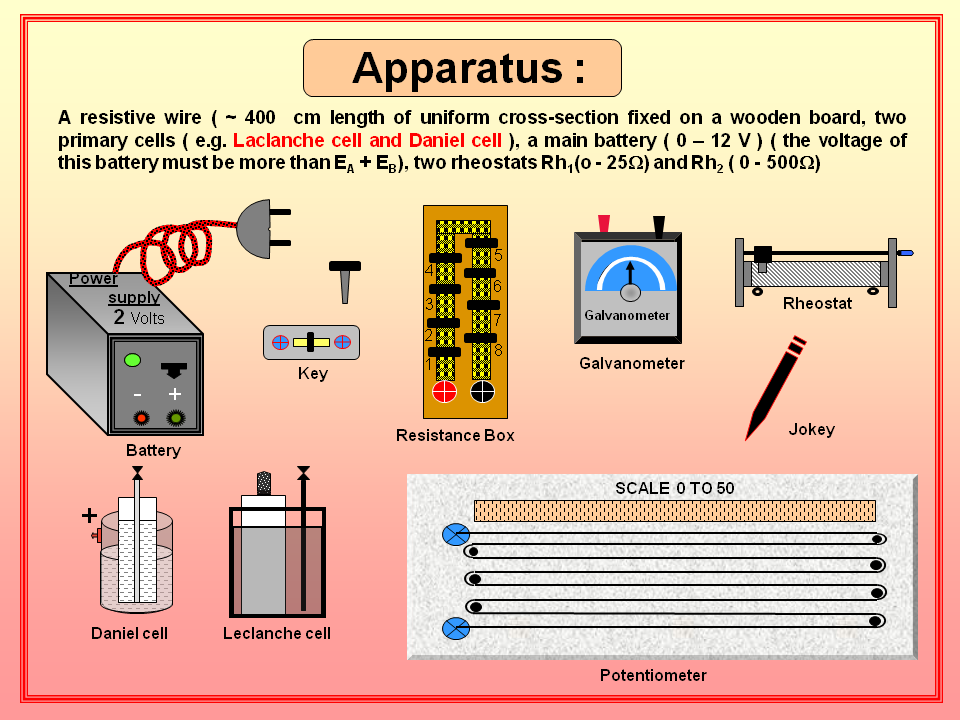
A resistive wire, Laclanche cell, Daniel cell, a main battery, two rheostats, Potentiometer, jokey, key, Galvanometer, Resistance box,
Apparatus for comparision of EMF
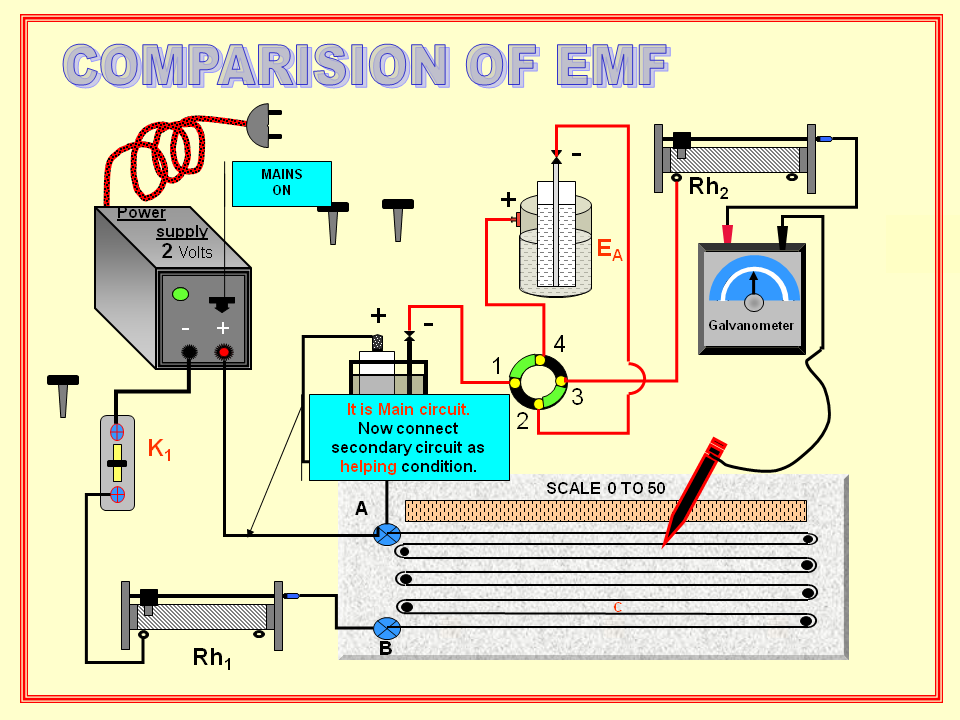
Adjust all apparatus as per shown here
Line Diagram fof Comparision of EMF
Comparison of EMF Practical
Comparison of EMF Practica
Comparison of EMF Practical Procedure
Calculation table for Comparison of EMF
Experiment  6(b)
AIM :-
Verify the results by joining both the cells in helping and opposing conditions.

APPARATUS :
A resistive wire ( ~ 400  cm length of uniform cross-section fixed on a wooden board, two primary cells ( e.g. Laclanche cell and Daniel cell ), a main battery ( 0 – 12 V ) ( the voltage of this battery must be more than EA + EB), two rheostats Rh1(o - 25W) and Rh2 ( 0 - 500W)
Apparatus of Comparision of EMF (ii)
PRECAUTIONS
1    First decide from experiment :6(a), which cell has larger emf. Call that cell EA and the other cell EB
2      Here, Rh1 should be having smaller resistance than Rh2.
3      The value of Rh1 should be the same while taking observations for EA and EB.
            For the observation of each set of helping-opposing conditions, the resistance in Rh1 should not be changed.
Line diagram Comparision of EMF (Helping Connection)
Comparision of EMF Practical

Comparision of EMF Practical
Result :
1  By connecting EA and EB separately :  EA / EB = ……………
2   By connecting EA and EB in helping and opposing conditions : EA / EB = ……..

Saturday, March 21, 2015

Cleaning capacity of soap in soft & hard water, Science practical GSEB for std 8 to 12.

Soap cleaning on hard and soft water

Soap Cleaning capacity


AIM :  To study the cleaning capacity of a sample of soap in soft water and hard water..

THEORY :  Hard water  contains salts of Ca and Mg that affects the cleaning capacity of soap. Hard water consumes  more soap.

APPARATUS :  250 ml glass beaker, glass rod, white cloth (two pieces of 7 cm * 7 cm), Hard water, Salts, Calcium Chloride, Magnesium chloride, Washing Soap, water soluble ink,

MATERIALS : Standard washing soap, distilled water, water soluble ink, calcium chloride or magnesium chloride.
Soap cleaning capacity Practical
Observation
( i)  Type of water in beaker no (1) :
( ii)  Type of water in beaker no (2) :
( iii)  From white cloth in which beaker ink-blot is removed (1) or (2) ?

Conclusion :

Uses :

Soft water give rich lather with soap, therefore its cleansing capacity is more than hard water. No more soap is wasted in soft water.