Wednesday, July 8, 2026

EFFECT OF TEMPERATURE ON RESISTANCE, GSEB Physics practical std 8 to 12

Effect of Temperature on Resistance


EFFECT OF TEMPERATURE ON RESISTANCE


AIM :-

You are given a Wheatstone bridge, a container filled with a liquid, a resistor made from an iron wire etc. Immerse the resistor in liquid and connect it in an appropriate arm of Wheatstone bridge. Measure the resistance at different temperatures. Draw the graph of resistance versus temperature and from it find the resistance at 200 c and 1000c. Use the following formula to determine(a ), the temperature coefficient of resistance.
Formula to calculate Effect of temperature on Resistance


PRINCIPLE  :-  On increasing the temperature of a conductor its resistance increases.

APPARATUS :- A coil of iron wire, container filled with liquid, a battery (2 V), a rheostat, a sensitive galvanometer, a simple key, a thermometer, a calorimeter, a burner, wire gauge, resistance box. 
Apparatus for Effect of Temperature on Resistance 
Practical Effect of Temperature on Resistance 
Procedure of Effect of Temperature on Resistance 
PRECAUTION :-               
(1)    Keep the iron cylinder completely immersed in liquid.
(2)    Keep all connections tight.
(3)    Stir the calorimeter for uniform heating of water. Note the temperature of the liquid immediately after the null point is obtained at every observations.
Graph of Effect of Temperature on Resistance
Draw the graph of Rt ® t. it is a linear graph. Extend this straight line on both the sides. Find R20 and R100 at the temperatures 20 0C and 100 0C respectively.
R20  = …………… W at temperature 20 0C
R100 = …………… W at temperature 100 0C
\     The temperature co-efficient of resistance of the given iron-wire is
RESULT :-  Temperature coefficient of resistance at given iron wire a = ………( 0c) -1

Beautiful Science Picture of Accessories use In Laboratory for students 8 to 12 std GSEB

Beautiful Science Accessories use in Laboratory.
Accessories used in Science Laboratory

Practical’s in chemistry and introduction of apparatus used
Before beginning the experiment in chemistry the student should have aware about
Principle,
Aim,
 Apparatus,
Chemicals used in experiments,
experimental method,
systematic note of  observation during the experiment chemical reactions and scientific conclusion.
                     
Apparatus used during the experiment :
            Test tube, Spatula, Tong, Stand, Test tube holder, Wire gauge, Tripod stand, Wash bottle, Measuring cylinder, Thistle funnel, Funnel, Distillation flask, Bunsen burner, Condenser, Watch glass, Dropper, Beaker, Conical flask, Evaporating dish etc.
During experiments, should not taste or drink solutions, nor touch or smell hot solutions or apparatus.
 If the need arises to smell, slowly and carefully do the same.
 Care should be taken to handle Bunsen burner.
 Glass rod should be used to stir the solution.
 Acid should always be added in the container containing water.

Test tube,
Spatula,
Tong,
Stand,
Test tube holder,
Tripod & wire gauge, 
Wash bottle, 
Measuring Cylinder,
Thistle funnel,
Funnel, Distillation flask,
Burner,
Condensor,
Watch glass,
Dropper,
Beaker,
Conical Flask, 
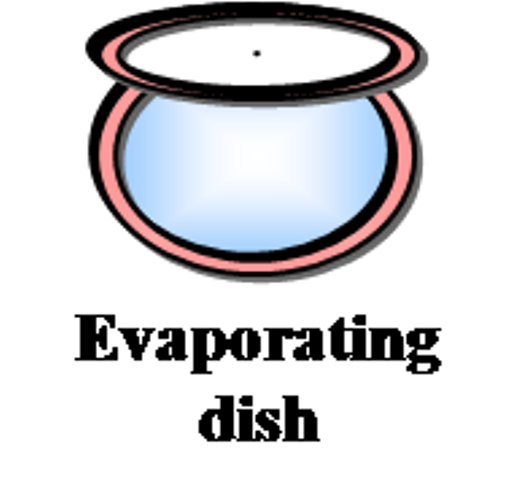
Evoparoting Dish,


Test tube

Spatula

Tong

Stand

Test tube Holder

Tripod stand and Wire gauge

Wash bottle

Measuring cylinder

Thistle funnel

Funnel

Distillation Flask

Bunsen Burner

Condenser

Watch Glass

Dropper

Beaker

Conical Flask

Evaporating dish

Post office box, principle of balanced Wheatstone bridge. physics practical std 11 & 12 GSEB

Post Office box
POST OFFICE BOX


Aim:-
A post office box and other necessary instruments are given to you. Take three appropriate ratios of the resistances in the two arms of Post Office Box and determine the values of two unknown resistances.
Now connect the unknown resistances in series and parallel respectively and verify the laws of series and parallel combinations of resistances.

PRINCIPLE :-
It works on the principle of balanced Wheatstone bridge.

APPARATUS :-
A Battery,
unknown resistance (Rx & Ry),
Post Office Box,
a galvanometer,
rheostat,
connecting wires

Post office box Apparatus

CONDITION  1 :- 
Connect unknown resistance      Rx between C and D
Post office line diagram condition 1
Post office condition 1 Practical
 CONDITION 2 :- 
Connect unknown resistance      Ry between C and D
 
Post office line diagram condition 2

Post office condition 2 practical

CONDITION 3 :- 
Connect unknown resistance      Rx & Ry in SERIES between C and D
Post office series connection 
Post office series connection practical
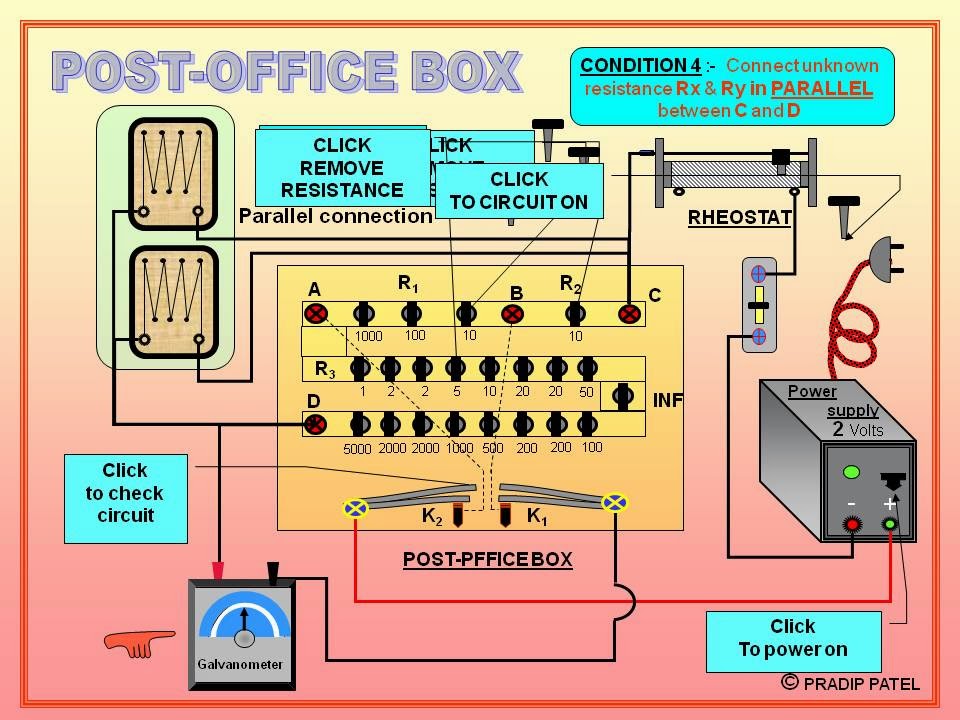
CONDITION 4 :- 
Connect unknown resistance      Rx & Ry in PARALLEL between C and D
Post office parallel connection condition 4
Post office box parallel connection 
Post office box observation table
Post office box calculations
Precautions
(1)   All plug keys of Post Office Box must be tight.
(2)    Contact points of K1 and K2 must be cleaned  with sand paper.
(3)    Galvanometer should be very sensitive.

(4)    Throughout the experiment  press key K2(battery key) first and then key K1(galvanometer key).

For more details view Video.
POST OFFICE BOX

Center punch for ITI fitter, Mechanic with animated video

Center Punch ITI Fitter
Center punch for ITI fitter, mechanic  with animated video.
Center punch for ITI fitter mechanical work.
It is made up of High Carbon Steel.
Center punch 
Pointer angle 90 degree.
Center punch 
Grind Center Punch.
Center punch use
Hold punch perpendicular to work piece
Center punch use and hammer stroke position
Work piece on which punching  is done

Hammer Stroke should be straight to the head of the punch.
Center punch use and hammer stroke position
You will get deep impression which is on punch shape in metal

Cross section of punch impression.
Center punch impression on metal
 Cross section Center punch impression on metal

More details view video
Grinding process of Center Punch practical with video.


Friday, June 12, 2026

REFRACTIVE INDEX OF GLASS PRISM measure with Glass Prism for std 11 & 12 GBSE

Refractive index of  Glass Prism


REFRACTIVE INDEX OF GLASS PRISM 

12.2  AIM :-
Using pins with a given prism determine the angles of deviation for six different values of angle of incidence. Draw the graph of angle of deviation versus angle of incidence. Determine, from this the angle of minimum deviation and using following formula determine refractive index of material of the prism.
Formula for Refractive index of Glass Prism


Angle of prism, A = ……. .

APPARATUS:  Glass Prism, Drawing paper, Drawing board, Pencil, Ruler, Pin, Protector,

FORMULA : - A + d = i + e

PROCEDURE :-
Take paper and pin it on Drawing board. 
Now take Glass prism and put it on center of Drawing board paper.
Mark the edges of the prism with pencil
Refractive index of  Glass Prism procedure
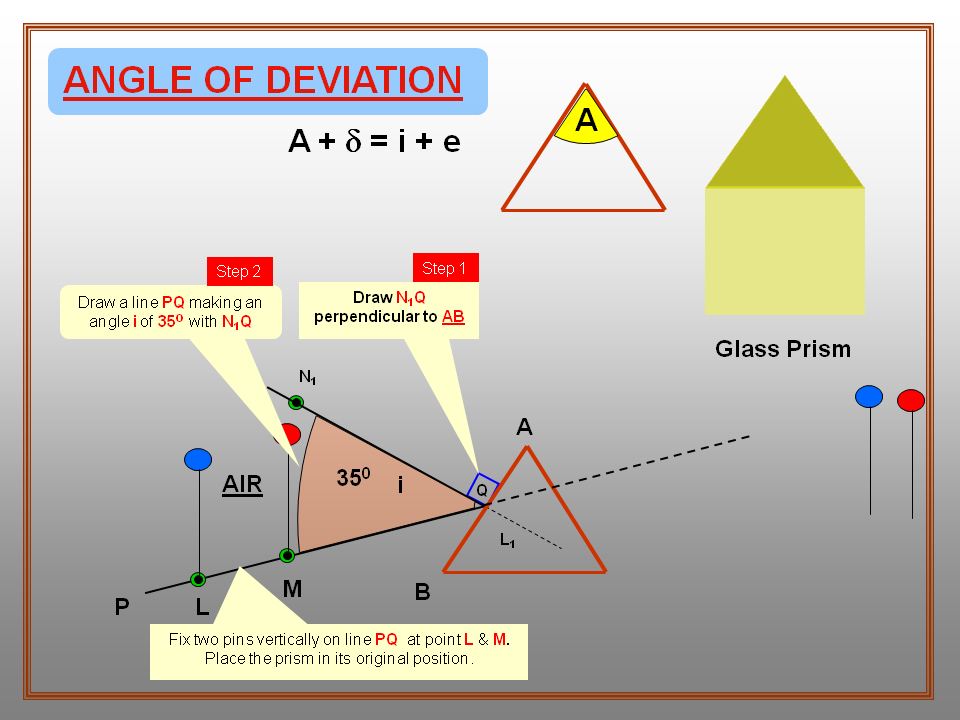
Draw N1Q perpendicular to AB
Draw a line PQ making an angle i of 35O with N1Q
NOTE :- Pins should be 3 – 4 cm. away from each other.
Fix two pins vertically on line PQ  at point L & M.
Refractive index of  Glass Prism procedure
Place the prism in its original position.
Refraction takes place QR after placing prism on its original place
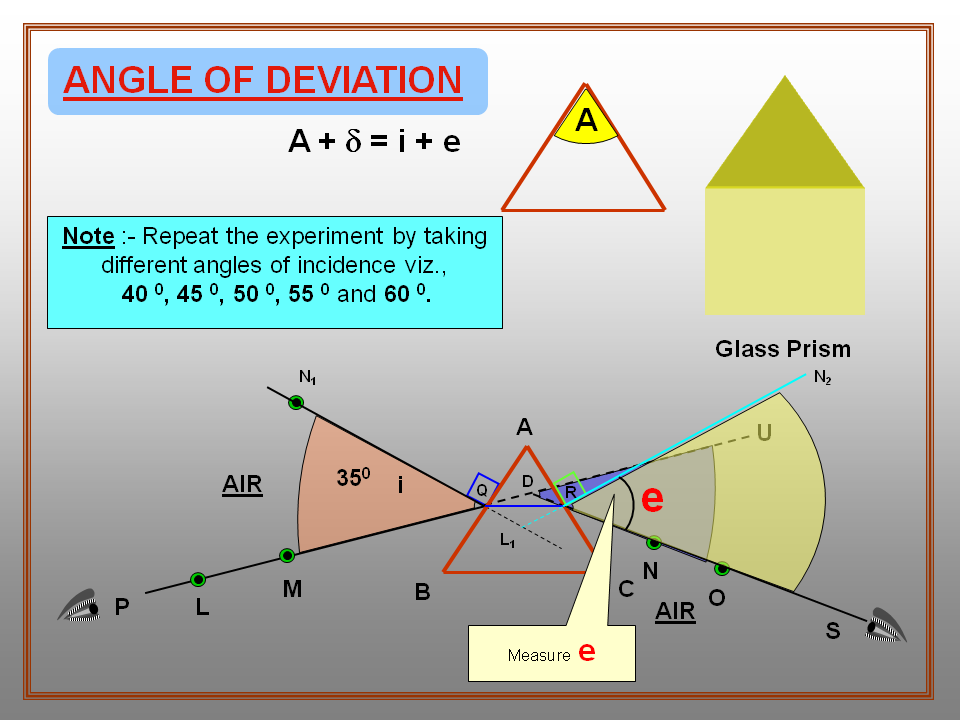
Now look from surface AC, adjust pin N & O vertically on the side which you are looking so that the images of the pins L & M and the pin N & O appear to be in the same straight line.
Refractive index of  Glass Prism procedure
Draw a line  SR
Measure d = Ð UDN
Refractive index of  Glass Prism procedure
Draw a line SR, and draw a perpendicular N2R at R to the line AC
Measure  e (Angle of Deviation)
Refractive index of  Glass Prism procedure
Note :- Repeat the experiment by taking different angles of incidence viz.,
 40 0, 45 0, 50 0, 55 0 and 60 0.

For more details View Video

Angle of Deviation.