Saturday, March 21, 2015

Foaming capacity of samples of soap, Science GSEB for std 8 to 12

Soap foaming capacity practical


AIM :    To compare the foaming capacity of three samples of soap.

THEORY :   On boiling vegetable oil or fats with caustic soda solution, sodium salt of fatty acids is obtained which is known as soap. Foaming capacity of different soaps are different from each other.

APPARATUS    :  Three big test tubes, measuring cylinder, stop watch, test tube stand, Vegetable oil, Caustic Soda, Sodium Salt, Fatty acid, Soaps, Distilled water.

CHEMICALS    : Three different types of sample of soap and distilled water.
Soap foaming capacity practical 
Soap foaming capacity

Observation
( i)  The time in which the foam just disappears in test tube (1) :      minute.
( ii)  The time in which the foam just disappears in test tube(2) :      minute.
( iii) The time in which the foam just disappears in test tube(3):       minute.

Conclusion  :


Uses : The foaming is less in the hard water. The foaming capacity of detergent is more than the foaming capacity of soap.

Friday, March 13, 2015

Atom and the Nucleus, nucleur fission and nuclear reactor process, for GSEB std 8 to 12 Science.

Neuclear reactor process.


Atom and the Nucleus.


Atom :- The smallest part of an element that can exist. It consists of a nucleus of protons and neutrons, surrounded by orbiting electrons.
Atom diagram

Moving process of Atom
Every single thing you can see, hear, feel, smell, and taste is made from microscopic particles. These particles are called atoms, and it would take millions of them just to cover a full-stop. An atom is itself made up of even smaller particles. In the center of each atom there is a nucleus made up of protons and neutrons. Particles called electrons whiz around this nucleus in different shell(layers). Protons and neutrons are much heavier than the electrons, so the nucleus makes up most of an atom’s mass. Some substances, such as water, are made up of molecules. These consist of several kinds of atoms joined together in a group. Other substances, such as iron, have just one kind of atom. 

Protons, Neutrons, & Electrons.
Proton, Neutron and Electron
The nucleus of every atom contains two types of particle protons and neutrons. The number of protons gives the atomic number. Protons have a positive electric charge, while neutrons have none. The electrons that spin around the nucleus, like planets orbiting the sun, have a negative charge. But electrons are not solid balls, they are bundles of energy that move almost as fast as light. There are always the same number of electrons and protons in an atom.

Nucleus.
Nucleus
A nucleus is made up of two types of particles, neutrons which do not carry any charge; and protons which carry a positive charge exactly equal in magnitude to that of an electron; i.e. 1.6 * 10-19  coulomb. Protons and neutrons have similar masses, but neutron is slightly heavier; both of them being much more massive than electrons. Neutron is 1838.65 times more massive than an electron, proton is 1836.12 times more than electron. The simplest nucleus is that of an atom of ordinary  hydrogen and consists of only a single proton. Both protons and neutrons are commonly known as nucleons.

The Schrodinger Model :-  abandoned the idea of precise orbits, replacing them with a description of the regions of space ( called orbitals) where the electrons were most likely to be found.

Orbitals:- electrons with various values of angular momentum occupy regions of space like these. Shading sows probability of finding an electron at that distance.

The Bohr Model :- ‘quantized’ the orbits in order to explain the stability of the atom.
Bohr's Model

The Rutherford Model :- pictured the atom as a miniature solar system with the electrons moving like planets around the nucleus.
The Rutherford Model

Scattering experiment by Rutherford.

Models of the Atom
Experimental data have been the impetus behind the creation and dismissal of physical models of the atom. Rutherford’s model, in which electrons move around a tightly packed, positively charged nucleus, successfully explained the results of scattering experiments, but was unable to explain discrete atomic emission—that is, why atoms emit only certain wavelengths of light. Bohr began with Rutherford’s model, but then postulated further that electrons can move only in certain quantized orbits; this model was able to explain certain qualities of discrete emission for hydrogen, but failed for other elements. Schrödinger’s model, in which an electron is described not in terms of definite paths but in terms of the likelihood of finding the electron in a particular region, can explain certain qualities of emission spectra for all elements; however, further refinements of the model, made throughout the 20th century, have been needed to explain further spectral phenomena.

Nucleur  fission process.
Nucleur  fission process

When a nucleus is bombarded with a neutron, it absorbs the neutron and then breaks up into two roughly equal nuclei. This process is called the nuclear fission.
Nuclear Reactor activity.
A nuclear reactor works on the principle of steadily sustained nuclear chain reaction. It uses fissile nuclei like 92u235  and Pu239 . Use  of appropriate moderator coolant and control rods are essential to the proper design of a reactor using some specific fissile material as fuel gives the scheme to a reactor using slow neutrons. The coolant flowing in through  X carries away the energy generated in the form of heat through Y.

Fission and Fusion Processes.
Fission and Fusion Processes
Nuclear energy can be released in two different ways: by fission (splitting) of a heavy nucleus, or by fusion (combining) of two light nuclei. In both cases energy is released because the products have a higher binding energy than the reactants. Fusion reactions are difficult to maintain because the nuclei repel each other, but, unlike fission reactions, fusion reactions create far less radioactivity.


Monday, March 2, 2015

Wave, wave motion, transverse wave, longitudinal wave gseb physics for std 11 &12


Wave and its Characteristics
Waves


Wave, wave motion, transverse wave, longitudinal wave gseb physics for std 11 &12
LET US FLOAT UP &  DOWN WITH
" WAVES "
CALM WATER BEHAVES  LIKE A PLANE  MIRROR, SO WE CAN SEE THE IMAGE ON IT.
WHEN  A STONE IS THROWN,  TRANSVERSE –WAVES PROPAGATE THROUGH WATER & THE IMAGE DISAPPEARS.
Waves 
DEFINITION:-
THE MOTION OF THE DISTURBANCE IN THE ELASTIC MEDIUM OR FREE SPACE IS CALLED A WAVE.

CHARACTERISTICS OF WAVE MOTION
1.WAVE MOTION IS A PERIODIC DISTURBANCE WHICH IS PRODUCED BY A VIBRATING BODY.
2.IN A WAVE MOTION,THE PARTICLES OF THE MEDIUM DO NOT MOVE FROM ONE PLACE TO ANOTHER.THEY ONLY VIBRATE ABOUT FIXED POSITIONS,PASSIVE ON ENERGY THEY POSSESS FROM PARTICLES TO PARTICLE.
3.A WAVE MOTION TRAVELS AT THE SAME SPEED IN ALL DIRECTIONS.
4.A WAVE MOTION TRANSFERS ENERGY FROM ONE POINT TO ANOTHER.IT DOES NOT TRANSFER ANY MATTER.
5.THE VELOCITY OF WAVE MOTION DEPENDS ONLY ON THE MEDIUM AND NOT ON THENATURE OR MOTION OF THE SOURCE.

TYPES OF WAVES.

TRANSEVERSE WAVES
Transverse wave
A WAVE IN WHICH THE PARTICLES OF THE MEDIUM VIBRATE UP AND DOWN AT RIGHT ANGLES TO THE DIRECTION OF WAVE MOTION IS CALLED A TRANSEVERSE WAVE.
EXAMPLES OF TRANSVERSE WAVE.
1.THE WAVES PRODUCED BY MOVING ONE END OF THE ROPE UP AND DOWN.
2.THE WAVES PRODUCED BY THROWING A STONE IN THE WATER.
3.LIGHT WAVES COMING FROM THE SUN.

LONGITUDINAL WAVES.
Longitudinal wave
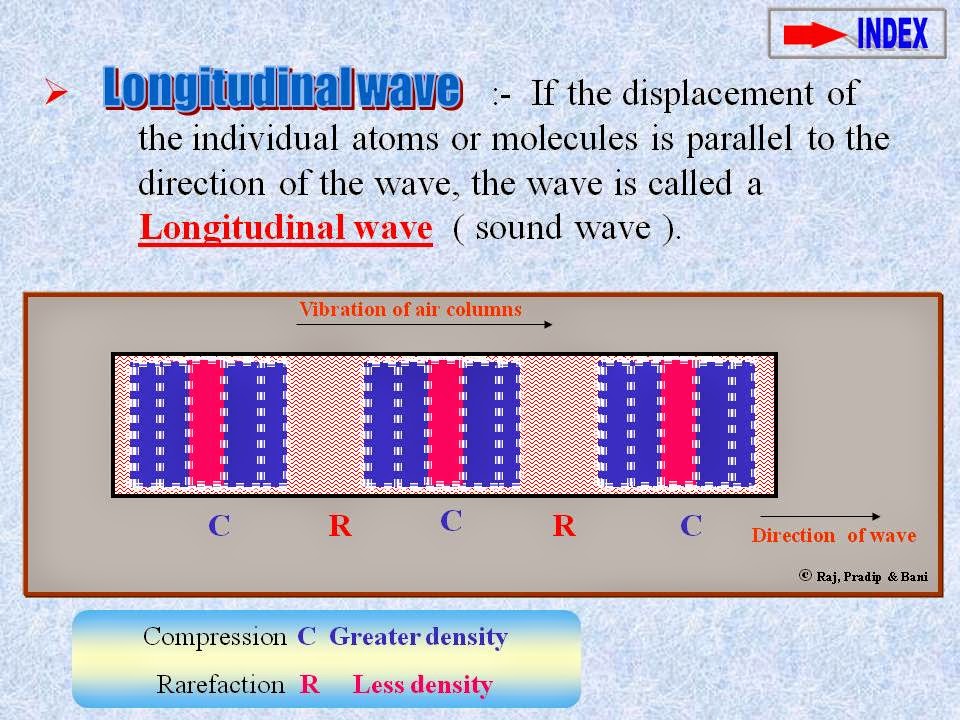
A WAVE IN WHICH THE PARTICLES OF THE MEDIUM VIBRATE BACK AND FORTH IN THE SAME DIRECTION OF THE WAVE IS CALLED A LONGITUDINAL WAVE.
EXAMPLES :-
1. THE WAVES WHICH TRAVEL ALONG A SPRING.     2. THE SOUNDS PRODUCED BY TABLA, VIOLIN,    SITAR  ETC.
                              DISPLACEMENT-DISTANCE  GRAPH  OF TRANSVERSE  WAVE.
DEFFERENCE :-
Transverse wave
THE ELEVATION IN A TRANSVERSE WAVE IS CALLED CREST.
THE DEPRESSION IN A TRANSVERSE WAVE IS CALLED TROUGH.

LONGITUDINAL  WAVE.
Longitudinal wave 
When a longitudinal wave passes through a medium, say air, some of the particles of air get crowded together and form compressions whereas other particles go farther apart and form rarefactions. A longitudinal wave is represented pictorially by showing the compressions and rarefactions.

Waves
waves index
Waves Frequency
Wave length
Waves Amplitude
Waves Velocity
Velocity calculation waves

Types of wave Transverse waves
Longitudinal wave
Standing waves
Musical instrumental waves
Wind instruments waves

wind instruments waves 
String instruments waves

Audible frequency wave
Ultrasonic and subsonic waves
Ultrasonic sounds wave
Ocen depth 
Seismograph 
Doppler effect 
Tuning fork
Acoustics of Auditorium
Test yourself
For more details View Video.
Waves

Sonometer find the frequency of alternating current, GSEB std 11 & 12 Physics practical

Sonometer

Sonometer


AIM :-
To find the frequency of the alternating current with the help of a sonometer.
PRECAUTIONS
1  It  is not advisable to use sonometer wire made of iron or any other magnetic materials.
2  The measurement of radius of the wire should be carried out precisely.
3  The transformer key should be switched off after every observation.
4  The wire should be kept exactly in the middle between the magnetic poles.
5  The wire should be of uniform cross-section and it should not have a twist or a bend.
Sonometer apparatus
Apparatus  :- A sonometer, horse-shoe magnet, a transformer, a pan, weights and a 
micrometer screw.

Sonometer practical


OBSERVATION TABLE

\ Average  √T/L =                        

For more details View Video
To find the frequency of the alternating current with the help of a sonometer.

Resonance tube Experiment for GSEB students of std 11 and 12, physics practical

Resonance tube Physics practical.
Resonance tube practical


AIM :-
To compare the frequencies of two tuning forks using a resonance tube and to find the end-correction. Repeat the experiment for two other tuning forks .find the lengths (l) of the resonating air columns for tuning forks of five different frequencies. Draw a graph of 1 / f ® l and find the end-correction
Calculation
(1) The linear density (i.e. mass per unit length) of the wire, m= prrr           .
(2) Calculation of  √T/L
(3) The frequency of alternating current f = 1 / 2L √T / m
                                                                               =  1 / 2 √m * (average √T/L )   

APPARATUS :-
A metallic tube open at both the ends (known as resonance tube), a cylinder( of glass or metal) for filling water, a stand, a meter rule, a rubber-pad and tuning forks( two of known frequencies and two of unknown frequencies).
Resonance tube apparatus
Resonance tube Practical

OBSERVATION TABLE
(1) Least count of the vernier callipers =                 cm
(2) Internal diameter of the resonance tube : d1 =                    cm;  d2 =                    cm
               \ Average diameter d =            cm 

Resonance tube practical reading 
(1)  f1 / f2 = l2 / l1

(2)  f3 / f4 = l4 / l3

For more details View Video.
Resonance tube Physics practical.