 |
| Ohm's Law |
Ohm's Law
AIM :-
A voltmeter, a current meter, and an unknown resistance etc.
are given to you. Prepare an appropriate circuit to verify Ohm’s law.
With appropriate values of current and
voltages, only with the help of calculations, determine the value of unknown resistance.
PRINCIPLE
Potential difference in a conductor produces electric
current.
APPARATUS :-
A unknown resistance,
a voltmeter (0 - 10 V),
a milliammeter (0 - 500mA), a battery,
a rheostat,
a tap key,
connecting wires.
PRECAUTIONS : -
- All the connections must be tight.
- Plastic or rubber should not be pressed below the
connecting terminals.
- When current does not flow in a circuit the pointer in
both ammeter and voltmeter must be on zero. If it is not so then adjust
the pointer on zero or consider the zero error.
- Range of the meters must be appropriate.
- Choose a proper scale while plotting the graph so that the graph is sufficiently large and it occupies most part of the graph-paper.
 |
| Ohm's Law apparatus |
 |
| Ohm's law Line diagram |
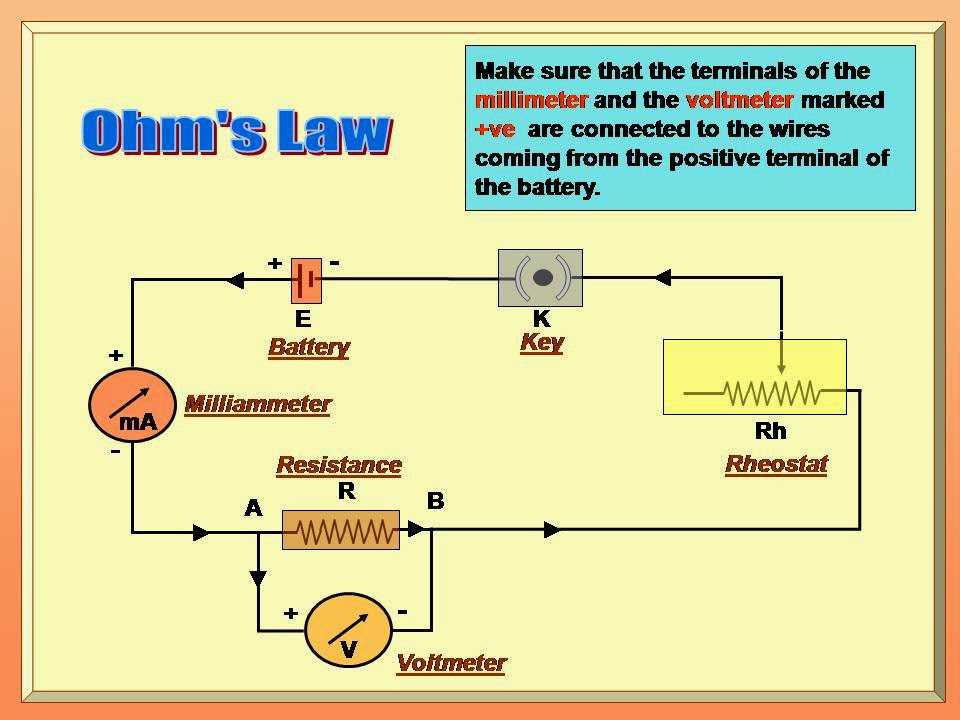 |
| Ohm's law line diagram |
 |
| Ohm's law practical |
 |
| Ohm's law observation table |
 |
| Ohm's law graph |
Ohm's Law


.PNG)


.PNG)
.PNG)

.PNG)